Se afișează postările cu eticheta Strange Fascination. Afișați toate postările

duminică, 12 februarie 2012

18. 1973 - Bowie's year

             By 1973 there was a recognisable Bowie cult in the UK, as 'Bowie Boys' and ' Bowie Girls' roamed suburbia.
             Although Bowie's records were being bought by everyone from teens to mums and dads, his hard-core following, those that actually took to the streets in make-up and glitter,seemed to consist of two types:

  • first, Bowie had a huge following among teenage girls
  • second, there were those arty suburbanites, the sexual experimenters, the bedsit gloomsters, who were drawn to Bowie's cleverness and his love for arty cross-referencing.
             Scientologist and writer, Simon Frith, wrote: " Bowie-ism was a way of life - style as meaning - and no other idol has had such an intense influence on his fans as David Bowie. His example of self- creation was serious and playful - image as art as image, and his tastes, the selves he created, were impeccably suburban: he read romantic literature ; he was obsessively, narcissistically, self-effacing....Bowie was youth culture not as collective hedonism but as individual grace that showed up everyone else as clods." In fact, Firth points out : "As a star, Bowie never pretended to "represent" his fans, but he did make available to those fans a way of being a "star"...Glam rock dissolved the star/fan division not by stars becoming one of the lads, but by the lads becoming their own stars. " 
             In May 1973 there was made a documentary by Bernard Falk - the programme recorded scenes of mass hysteria, screaming teenies and boys and girls dyed hair, glitter and the modish Aladdin Sane thunderbolt felt-tipped across their faces. This was the beginning of Bowie's immortality through style, and ,for his fans , it was this sense of sartorial danger which magnetised them.
             Bowie was freakish and other, and he presented the blueprint for all those bored suburbanites. Bowie, with his brand of self-absorption, his anti- countercultural poses and his revelry  in the surface trappings of glitz and artificiality, was the supreme expression of this new era of post- hippy, pre-punk questioning.
             By the end of 1973, Bowie had extricated himself from The Spiders and was about to bring his professional relationship with both Mick Ronson and Ken Scott to an end.
             'The 1980 Floor Show" was the last time Ronson and Bowie would share a stage for 10 years.
             The end of Bowie's working relationship with Ken Scott meant a shift of focus to more experimental techniques and arguably greater musical daring, and an end to the 'classic' pop period of David Bowie.
             Without question, 1973 will go down in history as Bowie's year. On New Year's Eve, RCA presented Bowie with a plaque to commemorate having 5 different albums in the chart simultaneously for a 19 - week period. RCA announced that his total UK sales were now 1.056.400 albums and 1.024.068 singles.
             Around this period, David would meet Ava Cherry - a striking black woman with short,platinum-blonde curls, perhaps several inches taller than Bowie himself. Bowie had met Ava in New York at the time of his Radio City Music Hall gigs in February 1973. Ava was a waitress at a party and Bowie soon had her earmarked as a future singing star. Cherry would now also be a regular backing singer for Bowie, and thee two would be romantically linked.

             Bowie's musical obsession were changing, and changing fast. What is certain is that, by the end of 1973, Bowie was already on the road to a more soul-inflected future.

17. Pin Ups

             The resulting album is uneven although beloved by many, and a massive-selling hit to boot. Personally,I'm not a huge fan of this album, it is one of my least favourites, and I'm going to be very short about this one.
             Released in October 1973, it was a UK Number 1 for 5 weeks, as Aladdin Sane had been, and rode the crest of the wave of Bowie's enormous UK popularity at the time.
             The album's highlight is, of course, his cover of The Merseys', 'Sorrow', the only time when he vastly improves the original.


             Bowie was again aping those around him, and this time it seemed to be Bryan Ferry. Although he never explicitly admitted to impersonating Ferry's richer, mannered croon, it was obvious to Scott and Ronson that this was the intention, and it was one thing they didn't altogether welcome with open arms. The album's only single release, "Sorrow",justifiably became one of his biggest hits,reaching Number 3 in Britain, and staying in the charts for 15 weeks, well into 1974.
             Perhaps more inspiring than the music was the startling cover - Bowie,naked again and next to him the personification of mid 60s cosmopolitan chic,Twiggy. Both look more like wind-up dolls than beings made of human flesh. The overall effect was that of a startling piece of artifice : the human condition reduced to simulacra .


16.Killing the Kabuki Monster

             As the Ziggy tour morphed into the Aladdin Sane tour in early 1973, the shows became even more ambitious.
             By the middle of 1973, Bowie had been on the road, almost non-stop, for 18 months, in a punishing schedule that included six British tours, two American tours and a tour of Japan - more than 170 gigs in all. The Japanese tour was also a huge success. At the start of the tour, Bowie was a virtual unknown with negligible record sales ; by the end, it was mass hysteria at the concerts.
             After the Japanese gigs, there was a large gap before the next gig, at London's Earl Court. His fear of flying meant that Bowie decided to return to Europe on the Trans-Siberian express.             
             As the summer drew closer Bowie was nearing exhaustion, despite the onset of what the tabloid media had dubbed 'Bowiemania',a level of hysteria not witnessed since the Fab Four in the mid-1960s. Bowie had gone mainstream with a vengeance with profiles on BBC's Nationwide, massive exposure on radio 1, and a avid interest from the tabloids and the rock press. However, on 12 May, The Spiders played a thoroughly dispirited gig at Earl's Court. The ambience was zero, the acoustics appalling because the PA was to small for the venue, and it was impossible to see the stage itself. It was one of the first times that Earls Court had been used for a rock concert, and the stage was also too low and fans couldn't even see it properly. It was one of the few real failures of the Ziggy/Aladdin Sane era. But no one could have expected Bowie's next move.

             " Not only is it the last show of the tour, but it's the last show that we'll ever do..... Bye bye. We love you. "


             Bowie's retirement announcement from the stage of Hammersmith Odeon, immortalised in that rather grainy DA Pennebaker film, left his fans in a state of complete disbelief. Bowie, just 18 months into his fame, was bowing out for good. Little did we know that this was not the end of the story but simply the conclusion of one chapter in Bowie's career: Ziggy and glam rock era were over.
             As a historical event, the Hammersmith gig has attained a mythic dimension. It wasn't the best gig The Spiders ever played, but it was their last, and it marked the end of an era. Although concealed from The Spiders until the night of the show, Bowie's announcement was in fact carefully leaked to the press beforehand.
             After the gig, Bowie threw a huge 'retirement' do, with Mick Jagger, Lou Reed, Ringo Starr, Barbara Streisand and Lulu all in attendance. the concert was a definite turning point for Bowie. He was shedding another skin that night at Hammersmith, throwing off glam rock and paving the way for a new, bolder era of experimentation. it was a rite passage.
             But why retire at the height of your fame? the answer lies in a combination of Bowie's low boredom threshold and, more importantly, his tour weariness. Bowie was genuinely exhausted after eighteen months' gigging. Just as Ziggy bit the dust at the end of the album, so Bowie used the Hammersmith Odeon show to fuel the myth and 'retire' in actuality. Since neither he nor his audience was sure whether it was David Bowie or Ziggy Stardust up there on stage, Bowie's fans assumed Bowie's retirement was the end of his,Bowie's,career,not simply that of his alter ego.
             There were also strictly commercial reasons behind the decision to bow out. Despite the sell- out tours, The Spiders were still receiving almost the same measly wage they had been on when Ziggy was an unknown.
             Ronson had become something of a huge live draw in his own right on the Bowie tours, and had his own fan base. With Bowie exhausted and off the road, in the second half of 1973 Defries turned his attention from Batman to Robin . He genuinely liked Ronson, and was also genuine in his appreciation of the Yorkshireman;s talents. So began the process of grooming Ronson for solo super-stardom.
             Finally, and most tellingly, Bowie was tired of the sort of music he was making with The Spiders. It seems that what actually drivers Bowie more than anything is not so much premeditated attempts to colonise markets, but a real hunger for musical experimentation. On Aladdin Sane ,Bowie had already begun, with Ronson's jazzy piano, to break free from the standard pop/rock format. Songs such as 'Panis in Detorit' hinted at a more obvious R&B/soul future. Bowie was,and still is, into all sorts of music, and by the middle of 1973 it was simply time for a change.
             Aladdin Sane had seen him move away from conventional pop, and his next planned project, an adaptation of George Orwell's tale of totalitarian terror,1984, would enable him to broaden the base of his music even further. Bowie wanted to move into mode serious intellectual territory outside the band format.
             First, though, there was a record company to appease. Bowie was now at a commercial peak. In the week beginning 23 July, 5 of his 6 albums were in Top40, 3 of them in the Top 15, an unprecedented feat for a solo artist. His next record, Pin Ups , a collection of covers from the 1964 - 1967 London club scene, was something of a stopgap. Certain that the next project did not need The Spiders, he was unsure of how to break the news that not only they were out of the picture as a live backing band, but that studio projects would not concern them either.
             Bowie was becoming a little more snappy with those around him. ' The success was changing him. Bowie began believing that all the trapping of success which Defries provided, the limos and that kind of thing, has to be there. In fact, they weren't trappings any more but necessities.'

15. Aladdin Sane


           Aladdin Sane has always been regarded as Ziggy's slightly inferior companion piece. Written in the main on tour in the States during the latter part of 1972, and released in the April of the following year, it was very much 'Ziggy goes to America' ,and English stylisation of American sounds, ideas and images.
            Aladdin Sane represented a definite step towards a harder, punchier sound. "It was almost like a treading-water album . But funnily enough, in retrospect, for me, it's the more successful album, because it's more informed about rock ' n' roll than Ziggy was", remembers Bowie.
            The Aladdin Sane character itself was a schizoid amalgamation, and the music reflected this fracturing down. Kent Scott remembers that,at the time, Bowie's own personality was undergoing series of quick- fire changes.
            Most of the Aladdin Sane album was written on the road during the autumn of 1972. Bowie himself was unsure of what direction to go in : " I kind of knew that I had said all that I could say about Ziggy, and what I'd end up doing would be "Ziggy Part 2"
            Speaking in 1993, Bowie told the BBC about the mythic quality America had at the time: " I don' know how much of a culture shock it is now....But I think for us back then, going to America was it. It used to blow us away. It was our own language, but it was this other world... Suddenly my songs didn't seem so out of place. "
            As with Ziggy Stardust , the cover shot for the album was as stylish as it contents. The album cover, a head-and-shoulder shot of Bowie with hair dyed reddish-orange and a painted thunderbolt splitting his face in two, is one of the most eye-catching and alarming ever made. The divine thunderbolt hinted at Bowie's continued fascination with the deification of pop idols. It split the face, and by implication the psyche , in two. Bowie didn't look like anything resembling a human being at all. The shot turned his physiognomy into a sort of tribal death mask, a shaman for the 1970s. When the album hit the shops in the spring of 1973, the cover was as startling  as rock  cover ever got.

Track list:


Side one

1. "Watch That Man" 4:30
2. "Aladdin Sane 5:06
3. "Drive-In Saturday" 4:33
4. "Panic in Detroit" 4:25
5. "Cracked Actor" 3:01


Side two

6. "Time" 5:15
7. "The Prettiest Star" 3:31
8. "Let's Spend the Night Together" 3:10
9. "The Jean Genie" 4:07
10. "Lady Grinning Soul"  3:54


            Aladdin Sane was recorded in New York and London,in January 1973. ' The Jean Genie' had been recorded for single release the previous November and was remixed by Ken Scott for the album. " It was done to be a big hit...Yeah,it's cute,but it's not one of my favourites. "
            The song was, of course, a homage of sorts, as Bowie reveals : "The Jean Genie was an ode to Iggy ".
            The single became Bowie's biggest seller to date, peaking at Number 2 just after Christmas. For the single release,MainMan funded Bowie's first ever promo,which was filmed over two days in San Francisco , starring actress Cyrinda Foxe,to add,as Rock says, "some local colour".  Foxe was a famous scenester and star of Warhol's film  Bad. David Bowie was now in love with Cyrinda and Angie had a new lover,Billy Doll.


            Drive-In Saturday , the second single off the album, was vastly superior, and it and Rebel rebel  are his finest glam-era singles.

            Time is one of his most successful songs from any period + five minutes of weird perfection. In the middle section Bowie heavy breathing, brought to the fore in the mix by Ken Scott, sets up a wonderfully overwrought tension to the melodrama. In the 90s, Suede would source this sort of Bowiesque moment on tracks such as The Power and The Beautiful Ones . This was always one of Ken Scott's favourite Bowie tracks.

            The beautiful ballad Lady Grinning Sould is,for Bowie, unusually sensual. Its direct, intimate appeal and lush mix, with twelve-string guitar and almost latino piano part, provide and unusually emotional and sexual ambience.


             The pivotal song on the album,though, is the title track, the clearest indicator of how Bowie was trying to free himself from the confines of rock. Mick Garson, his new pianist, was one of the main inspirations. Garson was on board and he would remain with Bowie for the next three years. Bowie was becoming jaded with pop / rock and,in Garson, he saw a talented, eccentric musician who he could learn from. It is no surprise that Bowie's experimental phase started with Aladdin Sane .


            Another track, the opener, Watch that Man ,has baffled fans for close on three decades. The question on most people's lips has been a simple one : "where the hell is David Bowie?" . Buried beneath a wall of glam-rock freak-out, the lyric is almost inaudible.


            Cracked Actor is one of my personal favourites, I love the live variants, and the way Bowie plays his role on stage.


            Panis in Detroit has an unique sound,and expresses David Bowie's fascination with the city.


            Aladdin Sane well and truly established Bowie as a major- league pop star, in the UK at least. On its release in April 1973, it debuted at the top of the UK charts. The album was Number One for 5 weeks.


14.The American Tour

I looked at the way Bowie presented himself in that whole 72-73 period and I just thought ,and  i still do to this day, that it was the greatest rock'n'roll star image that there has ever been
 Gary Numan 1998          

            In the autumn of 1972, Bowie set sail for the States. Already the biggest pop star to have emerged in the UK during 1972, it was vital that the holy grail of American success came Bowie's way. The Bowie contingent were on a high, full of hope, and sure that American success was just around the corner.
            One aspect of British pop that had completely failed to grab the Americans' attention was its androgyny. Whereas Britain has had an arty wing of lipstick-glossed rockers since the 1970s, America has, despite the early intervention of Little Richard, been very late in developing the tradition (with the Smashing Pumpkins, Nirvana, Nine Inch Nails or Suede)
            It's usually only a certain type of act that can clean up the dollars. In the 1970s, Elton John's high musical values in the studio and showmanship on stage made him the biggest-selling British artist there, with Rod Stewart not far behind. The largely anonymous Mick Jones sang his way to multi-dollar success,as did Fleetwood Mac,who were at least half-British. But the likes of art rockers Roxy Music went largely unloved. Bolan had had some limited success, but he was hardly a big star. Intensely competitive and driven, Bowie was determined to go one better.
            Back to the tour, Angie was an unwanted distraction on tour - after causing a disturbance in a hotel pool with one of her affairs late at night during a tour of the Southern States she was packed off home. From that moment on, Angie was never an integral part of Bowie's touring regimen. The cracks in the Bowie marriage were already beginning to show. Both were massively promiscuous, and when both started to parade their affairs in front of each other's noses (and then to make love to each other's friends), jealousy started to rot their 'open' relationship. Angie, convinced that Bowie and MainMan would make her a star, became increasingly disillusionated when the focus resolutely remained on her husband. 
            Despite generating a fortune for his record company and manager, the artist himself lived on advances, handouts and credit in rented accommodation in the UK, and hotels and apartments abroad. He lived in the myth of being David Bowie, driven, almost maniacally, from album to tour to album by a cold, indomitable will.
            Bowie's friends and workmates noticed him becoming more distant, and perhaps less friendly. Reminiscing in 2004, Bowie remembers feeling "displaced" : "There was a time when what I was doing...didn't seem to resemble anybody else was doing. I didn't understand what I was doing, but it just seemed out of touch with what everyone else was doing."
            Travis Bolder recalls: " We only saw him as we walked on stage. He separated himself from us towards the end, he was like a solo artist that didn't need us. The bigger he got, the bigger his head got, and the less important you were to him".
            Bowie signed an employment agreement with MainMan management and production company in September 1972 that assigned to Defries a 'timeless' term of office as Bowie's manager. Under the terms of agreement, Bowie was given a guaranteed allowance of 300 £ . In return, he'd signed his life away. Mainman had exclusive rights to Bowie's person and could also 'fictionalise' the singer's biography for press purposes. In effect, Mainman could tell a pack of lies about Bowie and he would have no comeback.
            By late 1973, as Ken Scott recollects, Defries' influence over Bowie was all-encompassing: " It was difficult to tell how much was David and how much was Defries"
            The MainMan days were possibly the most controversial of Bowie's career, involving as they did a hugely extravagant 'shagathon', with Bowie largely broke, and his wife Angie running up colossal debts in shoe shops and boutiques while desperately trying to cut as an actress ( she was later notably turned down for the lead in Wonder Woman)


            Friend and photographer Mick Rock puts it like this:
"It was part of the theatre to treat him like a star. Defries could then start talking about David having an exclusive photographer.  People were saying, 'David Bowie's got an exclusive photographer.Who the fuck is David Bowie?' The people reasoned: 'If he's got an exclusive photographer and bodyguards, there must be something going on. ' That was a piece of living theatre, if you like, part of the whole thing that Tony and David cooked up between them".


            Ken Scott remembers:
 " Defries made a fortune for himself! Bowie was completely stiffed by Defries and when something like that happens, you just pass it on, it's a fact of life.... Bowie got completely stiffed by Defries and he passed it on to others. Bowie had to become tight to survive and he just kept it going because he certainly wasn't tight to start with. Bowie was broke! He was putting on these incredibly extravant tours and he was paying for them completely out of his 50 per cent. it was completely unheard of! "


            The personality of Bowie's band was changing rapidly. The whole Bowie entourage was becoming considerably more weird than Bowie himself - he has just hired a new pianist, Mike Garson ,which was a scientologist.
            This general unrest among the ranks came at a time when Bowie was called upon to deliver new product, the first album to be written from a position of fame. In many cases such albums are either a frightened excursion in water-treading,with the artist cowed into giving the punters more of what they know ( the boring option and one preferred by artist too numerous to mention) , or a confused melody of paranoia and unhappiness in an interesting gee-it's-hell-at-the-top-having-all-this-money sort of way. For this new album, Bowie chose the second option, but fashioned the paranoia of the superstar into a fantastically innovative record.

sâmbătă, 28 ianuarie 2012

11.Ziggy Stardust

" I'm going out to bloody entertain, not just get up on a stage and knock off a few songs. I couldn't do that. I'm the last person to pretend that I'm a radio. I'd rather go out and be a colour television set. "
                                                                                            (Bowie in 1972)

    He had his own album. He had his own, very particular, hairdo, which was copied by both men and women. He brought cross- dressing, glitter and make-up to the high street. He's the most famous fictional rock star ever. He has a website devoted to him. He's had whole books written about his. Numerous tribute bands have sprung up in his wake, His last ever performance was turned into a film, a documentary about a complete fiction. There was even a Ziggy Stardust hotel in Thailand. His creator, David Bowie, ne Jones, has been inundated with offers to resurrect him in a musical. Quite simply, Ziggy made David Bowie a star. And Ziggy Stardust will go down in history as Bowie's finest creation.
    Bowie first mentioned his character Ziggy on a tour in America in 1971. 
    Ziggy was a composite rocker, and was based on two cult pop artists in particular.
  • One was the Legendary Stardust Cowboy - a sort of thrash country- and-western star
  • Vince Taylor (Bowie remembers: " He was out of his gourd. He was unfolding a map of the metropolis on the pavement, and he would just start pointing out sites where UFOs were going to land." ). Taylor was a cult figure possessed with a mad genius, his story was a rock'n'roll tragedy and a perfect example of rock martyrdom. (he died at the age of 52, in 1991 )
     Another immediate influence on the Ziggy creation was Stanley Kubrick's film version of the Anthony Burgess novel, A Clockwork Orange. 
     But perhaps the biggest influence of all came not from rock music at all, but from Japanese culture. First, Bowie has said that Japanese designer Kansai Yamamoto was "one hundred per cent responsible for the Ziggy haircut and colour ". Second, Japan's influence of Ziggy came from its peculiarly stylised theatre. Bowie was fascinated by Japanese kabuki and No theatre and appropriated their essence for the Aladdin Sane shows.
     In fact, there appear to be two quite distinct eras, The 1972 tours in support of Ziggy were rocky, punky and brash; not without theatricality, but still very much part of the accepted way of framing a rock gig. However, once Bowie started promoting Aladdin Sane in 1973, the costuming becomes far more elaborate and garish. And Bowie's fascination with all things Japanese was crucial in defining the Aladdin Sane era.
     In the West, Japan was traditionally viewed as an 'alien' culture. Bowie's Ziggy dignified Japanese culture and showed him open to ideas outside Anglo-American rock. Bowie helped internationalise pop, starring a long-running fascination with the East. He later became one of Japan's biggest idols.
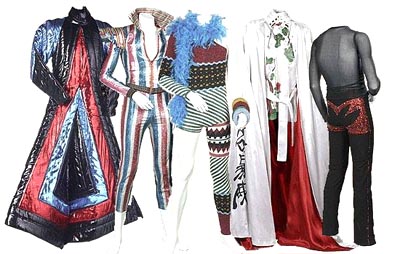
     The use of kabuki styles in rock performance was an innovation.Some of the costumes for the Ziggy Stardust and Aladdin Sane shows were actually first used in kabuki theatre, others were designed for Bowie by Kansai Yamamoto , again based on traditional designs.
 The overall visual effect of these shows was that of a blurring of 'found' symbols from science fiction - a space age high heels, glitter suits and the like - with kabuki-style garments whose effect was to signify the codes of another culture, one alien to Western society. Kabuki was perfect for the Aladdin Sane shows in that,by its very nature, it is a 'gender-bending' theatrical form.In Kabuki theatre,all parts,both men and women,are played by men. Its androgynous nature was elevated by Bowie to a position of fundamental importance.
     The constant changing of costume, so evident in both Ziggy and Aladdin Sane stage shows, also had its origins in kabuki. A change of kimono meant a change of personality.


vineri, 30 decembrie 2011

10.Andy Warhol and America


   With hindsigh,1971 was the year in which Bowie became something of a pop-art agent provocateur.What really fired him was the desire to be different,radically different,to challenge and overturn both  dominant musical conventions and the moral and sexual codes of his day.
    Bowie did indeed tart up his art in a radical and shocking manner.Linsday Kemp and his 1960s absurdist mime-and-dance troupe was an influence,and Bowie took a special interest in the Warhol scene too.For a promotional visit to the States in January 1971,Bowie took to wearing a man's dress,as designed by London's Mr Fish,and was threatened by a gun-toting redneck less than chuffed with the cut of Bowie's jib.
     During August,Bowie went to see Andy Warhol's Pork  at the Roundhouse,and befriended the cast of starlets,inlcuding several people who sould become apparatchick in MainMan,Tony Defries' management company: Tony Zanetta ( who would become Bowie's personal assistant),Wayne County ,Cherry Vanilla ( Bowie's future press agent),Leee Black Childers (his tour photographer),and the future president of MainMan Jaime Andrews.
    Bowie initially disappointed the The Pork crowd.Jayne County said of seeing Bowie on his club tour in early 1971: " We'd heard that David Bowie was supposed to be androgynous and everything,but then he came out with long hair,folky clothes,and sat on a stool and played folk songs.We were so disappointed with him.We looked over to him and said: " Just look a that folky old hippy!".
     "David was disappointing",said Leee Childers,"but we loved his wife,Angela Bowie.Angie was loud,she was pregnant,she was crazy,she was grabbing our crotches laughing it up,and having a good time."
    However,back in the UK,Bowie's stage performances were certainly causing more of a stir.As 1971 progressed,Bowie's sound became harder and harder.Anyway,everybody recalls that in the late 60s and earlt 1970s,Bowie was thought of primarily as a sonwwriter,eather than a performer. "Although very talented,he ended up making a career of being unsuccessful",remembers David Stopps (manager of the Friars Aylesbury venue).Stopps was also incredibly impressed with Bowie : " Bowie was fantastic".
    Rock acts like Bowie were as interested in breaking into the American market as they were in the UK.Bowie however,was naturally drawn to the fringes of American cultures and the likes of Iggy Pop,Lou Reed and Andy Warhol.
   In the autumn of 1971,he made a trip to the Factorz in New York.Bowie remembers Warhol as possessing a rather unearthly hue,his skin a preternatural waxy.On a personal level,the meeting itself was far from a howling success.Warhol apparently hated Bowie's tribute to him on the Hunky Dory  album,presented to him in the form of an acetate during the meet-and-greet,and was more interested in Bowie's shoes.


     In the Factory,Warhol constructed fame and made 'talentless' people into movie stars.Anyone could be a star (in only for fifteen minutes).
     In fact,Warhol and Bowie may be said to have shared many psychological states.Both had a morbid fear of premature death.With Bowie this manifested itself in a fear of being shot on stage,and the final Ziggy Stardust shows were redolent with references to his own mortality ( Time,My Death,Rock And Roll Suicide).Warhol only narrowly escaped with his life after being shot by Valerie Solanas,a radical feminist,in 1968.Both had an abiding fear of flying.Both had a consuming passion for notoriety and fame.Even their careers followed certain similiarities in trajectory.
     Warhol also 'reinvented himself',donning a wig to cover his baldness,changing the manner in which he spoke,the way he carried himself and his art and type.Perhaps most importantly,both Warhol and Bowie were unshamedly ' commercial ' in their art.Despite both men's link with the avant-garde,they flaunted the consumerism of popular art and eventually became businessmen themselves.Another major influence on Bowie and Warhol at the time came from the camp aesthetic,and its playfulness.
    This sense of playfulness,married with a Warholian sense of pop art,was relatively new stance in the earlt 70s,and the antithesis of commanding rock ideology at the time.So singers and performers,sometimes unwittingly,followed standards of excellence and decorum which,until Bowie,had never been fundamentally challenged before.For some writers in the 1970s,who totally missed the point,Bowie was all glitz and show,with no substance.

marți, 27 decembrie 2011

9.Hunky Dory

Tony Defries and David Bowie


   Tony Defries may have put Visconti off,but without him it's arguable wheter Bowie would have ever attained superstar status.Once Defries realised what he had,he channelled all his energies into making Bowie big.
   Visconti remembers about his decision to leave Bowie: " I decided to concentrate on Marc's blossoming career instead.It seemed more stable and more positive.I can't remember what we said to each other,but David had a very hurt expression on his face and I just turned and left quickly.I didn't feel all that great,but I couldn't stand Defries and I couldn't get it across to David that Defries awas not all that he seemed."
   With Defries,a new phase in Bowie's career was about to begin.


Zowie Bowie

    1971 was an enormously disciplined and prolific year,productive in more ways than one.On 30 May 1971,Bowie's son,named Duncan Zowie Haywood Jones was born in Bromley Hospital.


     It was a painful birth for Angie,who cracked her pelvis during the thirty0hour labour.Bowie himself was at home when the news of the arrival of his son was relayed to him,listening to a Neil Young record.Trading on the vibe of wistful folkiness,Bowie wrote "Kooks" ,a pastiche of early-70s Neil Young and a present for his new son.
     For their part,the arrival of little Zowie had little discernible impact either on David and Angie as a couple,or on Bowie's muse.Bowie had always liked children.His friends and work associates often comment that he;s good with their sons and daughters and finds time to play with them.Therefore,Angie and David were part-time mum and dad.It was onlt in the late 70s that Bowie realised he was missing out,and that his son needed his dad around.


   Profesionally,things really kicked into gear during 1971.
   Bowie began this period more as a songwriter than performer.He also spent a week in the hospital after he got the starting handle of the car impaled in his thigh narrowly missing a main artery.He also had many separate projects during 70-71s,mainly as a songwriter for other bands.


Hunky Dory


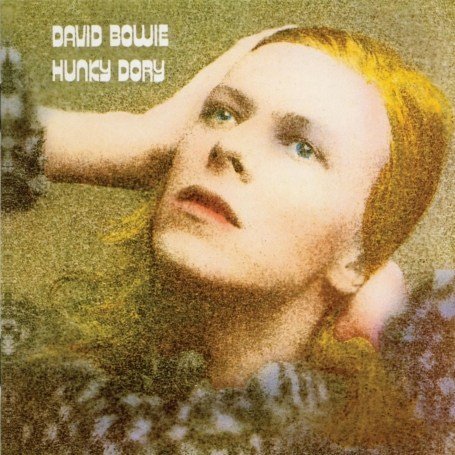
   Hunky Dorry is many people's favourite David Bowie album.It is one of my favourite albums aswell,and I think this the album I have listened to the most.I was absolutely in love with this album,and for a long period,this was my favourite.You can check my last.fm account :D.
   The work for the album started in late May 1971,and completed in August.
   Ken Scott says about the album: " On The Man Who Sold The World" he was still more of a trend-follower than a trend setter and it wasn't until Hunky Dory  ,when it was "To hell with everyone.I'm gonna do what I want to do",that he began to hit his stride.'
   Along with its successor Ziggy Stardust and Let's Dance from the 80s  Hunky Dory  is the album most likely to be found in the non-Bowie fan record collection.

Content:

Side one
  1. "Changes" – 3:37
  2. "Oh! You Pretty Things" – 3:12
  3. "Eight Line Poem" – 2:55
  4. "Life on Mars?" – 3:53
  5. "Kooks" – 2:53
  6. "Quicksand" – 5:08
Side two
  1. "Fill Your Heart" (Biff RosePaul Williams) – 3:07
  2. "Andy Warhol" – 3:56
  3. "Song for Bob Dylan" – 4:12
  4. "Queen Bitch" – 3:18
  5. "The Bewlay Brothers" – 5:22

   Side two has 3 tribute songs : to Warhol (Andy Warhol),(Dylan Song for Bob Dylan ) and The Velvet Underground and Lou Reed ( Queen Bitch ).With these three ,bowie redefined the notion of pop star as fan,and  elided the boundaries between the two.Of the three homages,Queen Bitch  works the best.It's probably Bowie's poppiest song from the earlt 70s never to be released as the A-side of a single,and is made all the more interesting by Bowie's curious and quite wonderful,vocal accenting.
   For The Bewlay Brothers ,Bowie looked inawrd.Thematically,the song updates and improves The Man Who Sold The World 's central concern of familial dysfunction.A series of weird-angle snapshots concentrate firmly on the concept of identity,its mutability,and its eventual disintegration: "I was Stone and he was Wax / So he could scream,and still relax,unbelievable" . The Bewlay Brothers  remains one of Bowie;s most disquieting moments on tape,and encapsulation of some distant,indefinable quality of expressionistic terror.


   Oh You Pretty Things  is a sort of 70s update of McCartney's Martha My Dear .Seeing ' cracks in the sky',certainly qualifies the young Bowie for a course of psychoanalysis,and the 'homo superior' and 'the golden ones' are direct references to the teachings of occultist Aleister Crowley.


   Another perennial favourite is the twee Kooks ,written for the newly born Zowie


  Quicksand  is almost Buddhist in its spiritualism - "Knowledge comes with death;s release "


Song for Bob Dylan  is probably the weakest song on the album,but its lyric analyses the lack of a hero figure in rock.Bowie had been much enamoured with Dylan.


    One song,the opening track,Changes ,was Bowie's edict for the 1970s.Bowie sings: " So I turned myself to face me / But I've never caught a glimpe / Of how the others must see the faker / I'm much too fast to take the test".The lyric emphasises the themes of identity,the mutability of character,and a sense of play with first and third person,providing us an important anticipatory signal for the creation of Ziggy Stardust.In the 1970s he had an almost pathological fear for repeating himself,not just musically but visually too.Most important,Bowie gave himself the epitet ' faker'.He announced himself as a pop's fraud;the arch-dissembler.In the middle-eight section Bowie sings: " Strange fascination,fascinates me / Changes are taking the place I'm going thru".
     The line in the last verse "Look out you rock'n'rollers",is crucial.Bowie is not only throwing down the gauntlet to existing rockers,but putting a distance between himself and rock fraternity.


   Life on Mars,a soaring,cinematic ballad,was an intentional parody of the quintessential standard My way .In fact,in Life on Mars Bowie settled a little-known musical score.Back in February 1968,Bowie was asked to submit a set of English lyrics for a French song,Comme D'Habitude .Bowie version Even a Fool Learns to Love  was rejected,and lyrics by Paul Anka were used instead - the result being Frank Sinatra's My Way. In 1993 David Bowie says : There was a sense of revenge in that because I was so angry that Paul Anka has done My Way I thought I'd do my own version.There  are clutches of melody in that were definite parodies."


    As for me,I love almost all the songs on the album - Life on Mars is a legendary song,that I would listen to any time,The Bewlay Brothers is one of the most listened  songs in my playlist,Changes is the track I always recommend to my friends when it comes to David Bowie,Oh You Pretty Things  is one of my personal favourites,and it's also the song I'm always singing in class with one of  my friends - which I salute now - btw,you're famous now!All my readers would love to meet you (Oh,the irony..what readers?).Kooks sounds really happy,and Bowie sings it in a different way.Quicksand has been one of my favourites David Bowie tracks,esspecially the line "Don't believe in yourself / Don't deceit with belief/Knowledge comes.....".I'm not that much into Queen Bitch  but it sounds very interesting,and I enjoy listening to it.

   Released just before Chrstmas,Hunky Dory had failed to dent even the lower reaches of the charts,and single Changes,also failed to chart.By this time,however,Bowie had another trick up his sleeve.Another album was already in the can,and he knew it was his best yet.

sâmbătă, 24 decembrie 2011

8.The Man Who Sold the World

The follow-up singles to 'Space oditty' were all commercial failures - 'The Prettiest Star','Memory of a Free Festival' and 'Holy Holy'.
Bowie's musical influences continued to be bizarrely eclectic,as Tony Visconti remembers :"It's no secret that he was always into The Velvet Underground.He also liked Van Morrison...He also liked that writer of 'Buzz The Fuzz'(Biff Rose),Jacque Brel ( the Mort Shuman English versions aswell),Ken Nordine,Marc Bolan'
Howver,the sound Bowie was developing both live and in the studio was becoming heavier,more focused and theatrical.The Man Who Sold The World ( released in Nov 1970 in the US and April 1971 in the UK),was decidedly more bleak and forbidding than the progressive chic of Space Oddity era.It's his most autobiographical work to date,it was also of real quality,a haunted piece of Gothic rock'n'roll,all sinister sgadings and bleak presents.
In an interview in 1993,Bowie spoke openly for the first time about the fear of insanity which hung over him in the 1970s and influenced a large proportion of his work : " There were far too many suicides for my liking - and that was something I was terribly fearful of. [...] As long as I could put those psychological excesses into my music and into my work I could always be throwing it off".

Content:
The Width Of A Circle
All The Madmen
Black Country Rock
After All
Running Gun Blues
Saviour Machine
She Shook Me Cold
The Man Who Sold The World
The Supermen


Against this background,the album's signature song has to be 'All the Madmen',which directly references his stepbrother Terry's plight ( he lived in the local asylum until his suicide in 1985).It empathises with him and contrasts the derangement of the internees with the corrupt values of a society which institutionalises madness.Lyrically,this is one of Bowie's most disturbing songs.Musically,the descant recorder gives the song a childlike dementia,like a seven-year-old's first music lesson turned evil.


'All the Madmen',like 'The Supermen',shows that the young Bowie was hip to Nietsche.Nietsche makes his madman rant and drool in the market square in a parody of the ravings of a demented preacher.
'After all' is the hidden gem on the album,a gorgeous melody with a somtach-churning merry-go-round synthesised section is the middle eight in waltz time.'After all ' is the first of Bowie's mini-manifestations for his chosen children,depicting himself and his flock 'painting our faces and dressing in thoughts from the skies'.With the line in the final verse,'Live till your rebirth and do what you will',Bowie is echoing the occultist teachings of the 18th and 19th century diabolist Aleister Crowley,whose maxim was 'Do what thou wilt'.Bowie seems to be envisaging a fan base of star-child occultists.


The much-lauded title track is lyrically Bowie's boldest statement yet of his sense of psychic unease.'The Man Who Sold The World' has a lilting melody,an almost bossa-nova-style rythm section.It was also covered in 1993 by Nirvana for their Unplugged session for MTV. 'I thought you'd died alone,a long,long time ago'.
'The Width Of A Circle' shows Bowie at his most daring.It containts Mick Ronson's most explosive moments on a Bowie album,as his lead guitar Kafkaesque transmogrification : 'Then I ran across a monster who was sleeping by a tree/And I looked and frowned and the monster was me'.
The closing track,'The Supermen',is just as sinister.The song is all towering spirals of sound.
The Man Who Sold The World depicts a world of almost satanic,neo-occultist perversion('The Width of a Circle'),a future hell in which the interface between man and machine has corrupted the species ('Saviour Machine'),where lust and dsire replace the sort of cosy,cliched,heterosexualised monogamy peddled by the pure pop tunesmiths of the 60s ('She shook me cold'.Bowie is haunted by the real possibility of his own personality shattering into so many constituent parts ('The Width...','All the Madmen','The Man Who...').
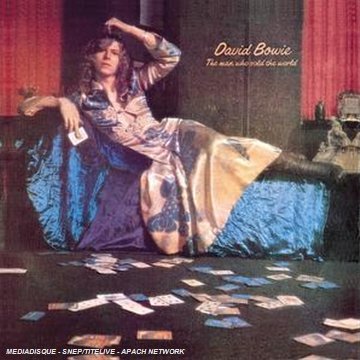
The album cover,which portays Bowie with flowing golden locks and wearing a full-length dress,is now a classic collector's item.Contrary to popular belief,the dress cover was never withdrawn from the US market because it was never actually used there in the first place.
Another interesting fact about the album is that the title was changed very late on in the day.The original title was Metrobolist.
The Man Who Sold the World also sounds so oddly formed and dark.The seeds of cyborg space-pop,later developed by the likes of the Futurists John Foxx,Gary Nauman,Bill Nelson and Thomas Dolby,are to be found on songs such as 'Saviour Machine'.The sort of childlike paranoia found on 'After All' and 'All the madmen' was a new form of Gothic melodrama,and a direct influence on Siouxsie and The Cure in the 70s and 80s,and America's Nine Inch Nails in the 90s.
Key to this bleak soundscape was Visconti and Bowie's desire to harness the newly arrived musical possibilities of the synthesizer.Visconti remembers : 'The synth was a passion of mine at the time'.


Howver,the actual recording of the album was a nightmare for the young Visconti.Accoding to Visconti,Bowie appeared distracted and undiciplined,spending more time with Angie in the lobby of the recording studio kissing,cuddling and cooing. ( 'naughty Uncle Tony says I have to do a vocal now.Bye bye Angie-wangie').Much of the music was 'arranged ' by Visconti and the band.
The album's protagonist was time and again arriving in the studio in a lyricless state,further driving the smoach-churned producer into a state of mild apoplexy.Visconti remembers : " Bowie was writing at the last minuste because (one),he wanted to,and (two) he was preocupied in the lobby of the studio with his new-found love,Angie."
The tactic of writing in the studio and coming up with lyrics for songs at the 11th hour may have fazed his friends,but Bowie was learning a new technique,which involved almost spontaneous last-minute assembly of a song's lyrical content in the studio.Bowie has never really been a concentional craftsman and,as his career progressed,he turned expediency into a tactic,developping a spontaneous creative environment.
The Man Who Sold The World worked well in artistic terms.As a commercial product,however,it was another near-fiasco,selling moderately for a while in the States,but disastrosly in the UK.Ronson went back to Hull to lvie with his parents and to work as a gardener.Moreover,shortly after the recording of the album,Visconti departed the Bowie scene to concentrate on his production work with Bolan.There was a number of reasons for Visconti quitting,but the main one was Bowie's business relationship with Defries.

____________________________________________

The Man Who Sold The World is one of my favourite albums ( you will hear this a lot from me,though!).My personal favourites are : 'All the Madmen' - I think the lyrics are phenomenal.This is one of the songs I always sing in class and annoy my classmates.The Man Who Sold The World is,lyrically,one of Bowie best works.The lyrics attracted me in the first place,and this is also one of the first Bowie songs I have heard.'Saviour Machine','She Shook Me Cold' and 'Black Country Rock' are relatively new to my "Loved Songs" section.

marți, 20 decembrie 2011

7.Look out all you rock'n'rollers,1970-1972

" We never got off on all that revolution stuff
Such a drag - too many snags "

[Mott the Hoople,"All the Young Dudes",1972,words and music by David Bowie]

And here we are!Finally we are going to speak about glam,and we have finally arrived to David's 'golden age'.

How did Bowie start the decade?Not only with his first hit single under his belt,but also with a string of commercial and artistic failures to his name,too.In 1970,he made a number of important commercial and personal decisions which would dictate the course of his career for the first half of the decade.
First,he sacked his manager,Ken Pitt;second,he 'invented' glam rock;third,he hooked up with a inexperienced rock manager but very smart businessman-lawyer named Tony Defries;and last,he decided to get angaged to his girlfriend,Angela Barnett,who for a while basket in his limelight and joined his spangled journey to stardom.

A. The Marc Bolan - David Bowie dispute

The dispute is related to who has actually started the whole glam thing off.Marc Bolan was the first to have use glitter in his 1971 Top of the Pops show,and he claims being the godfather of glam.However,what mattered most to Bolan was stardom at any cost.Tony Visconti says: "Marc's weakness was his sense that he had 'arrived',and he never developed himself as a musician beyond the stage he was at during his hit-single years.He also got caught liying too many times - he felt he could sau anything to manipulate journalists.His tall tales were legend!David never shared any of Marc's weaknesses".Marc was less of a diplomat than Bowie,and tended to piss people off more easily.
In many respects,Bolan paved the way for Bowie.Bowie himself wrote in 1998: " The little imp opened the door".
Both had ploughed similar furrows in the late 1960s.Both were from a folk-pop base,but Bolan made the transition from minority acoustic elfin cult artist to mainstream - rogering pop god first.Bowie followed,doing it better,and taking it further,but Bolan had opened the door.


B. The Glam Era

Calling it a glam "movement" is a bit of a misnomer as it implies a sort of united front.There were far too few American bands to actually even form a glam-rock scene over there.A scene did exist centred around the Warhol crowd in New York in 1970/71,an absrudist movement concerned not so much with music,but with theatre and film.
Very broadly speaking,there were always two wings of glam,or "glitter" rock as it was more referred to at the time:

a)there was the arty,serious,more subversive end :
- David Bowie
- Roxy Music
- The New York Dolls
- Alice Cooper
- Lou Reed ( for a time )

b)then,there were the lads in silly trousers
- Gary Glitter
- Sweet
- Alvin Stardust


With the exception of Suzi Quatro( this girl is amazing,you should try some of her songs,esspecially Stumbulin' In,with Chrish Norman),glam was almost overwhelmingly male as well as overwhelmingly heterosexual.Despite all the limp-wristedness,few of the glam-rock acts were actually gay.Elton John 'came out' in 1976,well after the high-water mark of the glam-rock movement.For the first half of the 70s,Elton was at pains to hide his homosexuality from the media and his fans.Lou Reed,whose bisexuality was an obvious factor,stayed on the glam bandgagon for one album only.
No,UK glam rock was unremittigly male and laddish,despite the make-up and posing.Gary Glitter was the "leader of the gang".The Sweet,too,were all lads together,'hell raising' on a 'teenage rampage',while Slade ( this guys are also gorgeous,try 'Far Far Away')the boozing Midlands skinheads-turned-glitter-freaks,and probably the best of glam pop bands at the time,also demonstrated their impeccably laddish credentials by misspelling their half dozen hits ( Far Far Away is an amazing song,listen to it :D ).
But you had to have real nerve to be,or indeed even to look like,David Bowie.He soon had a community of fans who dared to be different and who ,as we shall see,were a ace apart from the rest of the glam-rock fans.
In general,Bowie was dismissive of most of the competition,although Alice Cooper (with School's Out for Summer),Elton John and Rod Stewart and The Faces were releasing very strong material in 1972 and 1973.Bowie's competition with Bolan was a feature of the 'glam wats' during the period.One of the few contemporary acts Bowie had any time for would appear to have been Roxy Music.Some critics consider Roxy Music and possibly Steve Harley and Cockney Rebel as the only true glam-rock bands in that they actually started their professional careers as glam or art-rock acts,rather than twiddly folkies.
The glam era was possibly the last big male-band era in UK pop:

- Gary Glitter ( 3 nr 1s,4 nr 2s) VS Sweet ( 1 nr 1, 4 nr 2s) VS Slade (6.1,3.2) VS T-Rex ( 4.1,4.2) VS Wizzard (2.1)

This was an intensely competitive period.That's why the Oasis VS Blur face-off in 1995,when the two Britpop acts schedueled their single relaes for the same day,was important.


So,what was glam rock all about?Was it simply,as John Lennon once put pit "just rock'n'roll with lipstick on'?
Glam rock definitely had a more show-business side,in form of the often fun Gary Glitter and the hardly ever fun Alvin Stardust.
The Bowie version of glam was as much to do with the floutinf of gender codes and injecting a certain artiness and detachement into popular music as with attempts to shock the masses in the era of hippy,joss-stick-tingled stupefaction.Its origins are to be found in figures such as Little Richard,whose stage persona was flamboyantly garish and androginous.
Syd Barrett,the first of the 60s psychedelic performers to wear make-up and an acknowledged influence on Bowie in particular.Before his collapse into mental illness,Barrett briefly promised an alarming future for pop,a future full of space-out tripping and flaunted convention.Barrett prefigured Bowie's space-age fascination wish songs such as 'Interstellar Overdrive','Astromine Domine','Arnold Layne'.Had Barrett continued,there might have been less room for Bowie to manoeuvre in the 1970s.But he didin't.By the earlt 1970s,he was,very sadly,a comatose wreck,pop's most famous acid casualty;an innovator destroyed before his prime.
In the hands of Bowie,glam challenged pop's masculine ethos.Bowie's version of glam was about gender violence.Lou Reed and Iggy Pop only started to wear obtrusive make-up on stage once Bowie and Bolan had begun to do so.
Soon,every self-respecting British teen band to have at least one of its members kitted out in a fake leopard-skin jumpsuit with assorted glittery attachements.Bowie,however,had very little to do with these glitter rockers.

Hype

The origins of glam,Bowie-style,can be traced back to the very first months of the 70s.At the Roundhouse in London,in February 1970,Bowie and his band,Hype,played one of the most significant and most indifferently received concerts in rock history.
Hype were intended as a cartoonesque caper,a sort of rock'n'roll pantomime for the new decade,and the name was intended to run counter hippy-era notions of an anti-commercialistic rock community.Bowie was Rainbow Man,wearing a cape of many colours and lots of diaphanous scarves.Drummer John Cambridge was Cowboy Man,Mick Ronson on lead guitar was Gangster Man,wearing a borrowed gold lame suit from Bowie,and bassist Tony Visconti was Hype Man,a kind of comic-book superhero.
Bowie is in no doubt that this was the first British glam-rock gig.Marc Bolan-in an attempt to get into the theatricality of the project- stood at the foot of the stage wearing a child's plastic Roman breastplate.
Tony Visconti,about the concert: " I think that is the night that the germ of glam rock was born "


David Bowie and Mick Ronson


Ronson was a very important musical component in the Bowie sound at the time.
Visconti remembers him as charming,but adds: "He always looked a bit lost;he hardly had an ambitious bone in his body."
Gus Dungeon also remembers Ronno with great affection: "He was also an utterly charming fellow,I mean,just a total sweetheart and desperately embarassed at having to pull all those stunts every night during the Ziggy period.He hated doing it.He was very shy."


David Bowie and Angela

Bowie was also by now a married man.On 20 March 1970,he and Angie were wed at Beckenham Registry Office.Angie was dressed in a second hand,purple and pink,floral silk dress bought the day before.David wore tight leather trousers,black satin shirt and Afghan coat,cut something of an unconventional dash for the wedding day.Instead of rings they exchaned Peruvian bangles during the brief ceremony.The night before their wedding was spent in bed with a mutual friend.The night after was spent down the pub getting blasted.

 Angela acted as a behind-the-scenes promoter of her husband's talents,persuading and pressurising record companies and pluggers,helping with the costumes,making phone calls,suggesting ideas,entertaining friends,listening to Bowie's work-in-progress.
 She was also into outrage and bisexuality in a big way;her hair was often shorter,spikier and punkier than her husband's.
 Many contemporaries are at pains to poit out that Bowie only really weirdified his image after living with Angie.Before the Angie years,Bowie was actually fairly quiet as an individual and had not yet discovered the flair for sartorial flamboyance we now assosicate with him.
 Angiw would constantly encourage Bowie to try on new,and ever weider,designs.


 Bowie and Angie always had a love\hate relationship.Manager Ken Pitt apparently strongly disliked her.Gud Dudgeon didin't get Angie either : " I thought she was just a typical groupie.I just thought she was really loud and full of crap and I still do."
Ken Scott says about her: "She was very flamboyant.When she walked into a room,you knew it.Musically she had no influence whatsoever.She would stop by the studio once in a while with a 'Hello,dahlings!Oh,that's lovely,yes!' and then go out and so some more shopping or something.But she was fine.I had no problems with her"

According to Angie's second biography,Bowie was quite upfront about his feelings.He told her back in 1969 that he didn't really love her,and if they married it would be something of a marriage of convenience.'Their relationship,though,was weird;supposedly an "open relationship"' says Scott 'But every time I've heard of that,it always ends up with someone jealous,and that's what eventually happened.'

Tony Visconti says about Angie: "She was there for him in a difficult transitional period.But I could see when this wasn't enough for her.At one concert David was surrounded by fans and Angie was next to him dressed even more outrageously than he was (her breasts were visible).Since all the attention was on him,she feigned fainting (something she did often) and suddently she created an emergency drama around herself,taking the limelight away from David."

For a while tough,everyone was a big happy family.Bowie and Angie had soon turned their home into something of a sex-and-style laboratory,picking up blokes and girls from venues such as gay disco The Sombrero,a nigh-spot frequented by Bowie mainly as a way to get a hit of the flamboyance of gay style.
Visconti remembers moving in with his wife Liz,at Bowie and Angie's place. " Bowie was the only one among us who had any money.[...] As for wild sex - it only happened occasionally.David and Angela never tried to invove us in their sexcapades"

The Haddon Hall (their house) was apparently haunted,and Bowie spent some of the most creative years of his life there,tapping into the eerie vibe of this rambling Victorian mansion.
It was in this spooky mansion that Bowie and Angie set about starting a family of their own.By the end of the summer of 1970,Angie was pregnant.

6.Space Oddity (1969)

For Bowie,the first part of 1969 ran much as 1968 and 1967 had done : plenty of ideas,plenty of energy,but no commercial success.
His apprenticeship had to draw a close soon,and it did with his first hit single,'Space Oditty',written as a response to Stanley Kubrick's 2001:A space Odyssey.Commonly regarded as one of the best singles of his career,'Space Oditty' came in at Number 14 in a 2005 Virgin Radio poll of the Top 500 singles of all time.
'Space Oditty' remains a beautifully haunting,if dated,masterpiece,a tale of alientaion which thematically prefigured much of Bowie's work in the decade to come,telling the tale of astronaut Major Tom,destined to roam the universe for ever: 'Planet Earth is blue\And there's nothing I can do'.
Interestingly for a pop song from that era,'Space Oditty' has no chorus.It's a seamless dialogue,a perfectly paced unravelling of events,and is the possessor of an instantly memorable melody,a superlative acoustic guitar riff and echoey hand clap for the middle-eight,and a lyric which burned its way in all its childlike beauty into the public consciousness.
The BBC didn't allow it to be played until the guys got back from the moon. ( Apollo 11 ).As soon as they got back it started being played again,and subsequently charted and continued up.The single was given its first public airing on 6 July 1969,and it took three months to actually hit the Top 40.He collaborated for the single with Gus Dudgeon.
Tragically,Gus and his wife,Sheila were killed in a car crash on 21 July 2002.Dudgeon was 59.Before the fatal accident,Dudgeon's lawyers had initiated a legal action against David Bowie for unpaid royalties.Bowie sent flowers to his funeral,with the message: " Farewell to the Laughing Gnome".
Far from being simply a cash-in single,'Space Oditty' was the first indication of Bowie's interest in outer space as a metaphor for inner space.Paul Buckmaster remembers Bowie as being very taken with the whole sci-fi vibe at the time.
Tony Visconti also remembers Bowie being very bookish.He also remembers Bowie as a UFO-spotter,though Bowie has given the impression that it was a passing phase.
Given the comic-book nature of Bowie's interests at the time,as a piece of sci-fi writing 'Space oditty' is remarkably,perhaps deliberately,naive.Rather than dealing with the correct terminology,Bowie's lyrics are childlike and auaint.So we get 'ground control' for 'mission control','space ship' for 'rocket','Major Tom' instead of ,perhaps, 'Commander Tom'. The result is that Major Tom is a puppet,a Mr Punch launched into space in a atoilet-roll rocket covered in tin foil,slying around in the nursery ceiling rather than the cosmos.In this respect,'Space Oditty' is merely just another 'Laughing Gnome'.
Intentionally or not,the single 'Space Oditty' acted as a requiem for the flower power age "Planet Earth is blue\And there's nothing I can do".
'Space Oditty' was Bowie's first 'classic; single,and has also entered the ranks of the rock mondegreens,or famously misheard lyrics,with the line 'Ground control to Mao Tse-tung' ( :D ) . It has been followed up not only by Bowie's own 'Ashes to Ashes ' 1980 but also by Pete Schiling's Euro hit of 1984,'Major Tom (coming home)'.And ,of course,three years after 'Space Oditty' was recorded,producer Gud Dudgeon went on the cut the thematically very similar 'Rocket Man' with Elton John.
Sadly for Bowie,the single became a hit just a matter of weeks after the sudden death of his father from lobar pneumonia in August 1969.Without the support of his dad,Bowie increasingly turned to others for professional and emotional succour.Angie was the most important of these but other workmates such as Tony Visconti were by now very close to Bowie,too.After the death of his father,Bowie had only sporadic contact with his mum throughout the 70s,and she complained bitterly that her son had abandoned her,and Terry,during the period of his greatest fame.She did,however,attend her son's perfomance as the elephant man on Broadway in 1980,and his marriage to Iman in 1992,and,according to reports,the two became close again during the 90s.Peggy later moved into a private residential old people's home near Watford,where she lived until her death in April 2001.

Bowie's second album came out in the autumn of 1969.It was certainly more coherent and less scatty than his first Deram effort,but 'Space Oditty' aside,there was little to suggest the greatness to come.


Space Oditty ( 1969) content:
1.Space oditty
2. Unwashed And Somewhat Slightly Dazed
3.(Don't Sit Down)
4.Letter to Hermione
5. Cygnet Committee
6.Janine
7.An Occasional Dream
8.Wild Eyed Boy From Freecloud 1
9.God Know's I'm Good
10. Memory Of A Free Festival ( part 1 and part 2)
11.Conversation Piece

My personal favourites are,besides Space Oditty,Letter to Hermione,Cygnet Committee and An Occasional Dream.
'Unwashed And Somewhat Slightly Dazed' is a country-meets-prog-rock collision of ideas.Lirically,however,the most important song is also the most direct - 'Janine'.On 'An Occasional Dream' and "Letter to Hermione",which concerns his first real love,Bowie is as vulnerable and quavering,almost feminised,as the love he sings about.'Space Oditty' itself was an exceptional song,and a deserved hit single in the UK,staying in the UK charts for fourteen weeks.
Despite the hit single,the new album flopped badly,as did the follow-up to 'Space Oditty','The Prettiest Star' ( ironically,while I'm writing this,my winamp is playing 'The Prettiest Star,from his 1973 album,Aladdin Sane :D ; anyway,this has nothing to do with the 60s.)
By 1970,Bowie had become skilful at communicating with music journalists: charming,good-looking and intelligent,he had already learned the art of keeping the caption-writers in the weekly music press fully employed.