Se afișează postările cu eticheta Angie. Afișați toate postările

duminică, 12 februarie 2012

14.The American Tour

I looked at the way Bowie presented himself in that whole 72-73 period and I just thought ,and  i still do to this day, that it was the greatest rock'n'roll star image that there has ever been
 Gary Numan 1998          

            In the autumn of 1972, Bowie set sail for the States. Already the biggest pop star to have emerged in the UK during 1972, it was vital that the holy grail of American success came Bowie's way. The Bowie contingent were on a high, full of hope, and sure that American success was just around the corner.
            One aspect of British pop that had completely failed to grab the Americans' attention was its androgyny. Whereas Britain has had an arty wing of lipstick-glossed rockers since the 1970s, America has, despite the early intervention of Little Richard, been very late in developing the tradition (with the Smashing Pumpkins, Nirvana, Nine Inch Nails or Suede)
            It's usually only a certain type of act that can clean up the dollars. In the 1970s, Elton John's high musical values in the studio and showmanship on stage made him the biggest-selling British artist there, with Rod Stewart not far behind. The largely anonymous Mick Jones sang his way to multi-dollar success,as did Fleetwood Mac,who were at least half-British. But the likes of art rockers Roxy Music went largely unloved. Bolan had had some limited success, but he was hardly a big star. Intensely competitive and driven, Bowie was determined to go one better.
            Back to the tour, Angie was an unwanted distraction on tour - after causing a disturbance in a hotel pool with one of her affairs late at night during a tour of the Southern States she was packed off home. From that moment on, Angie was never an integral part of Bowie's touring regimen. The cracks in the Bowie marriage were already beginning to show. Both were massively promiscuous, and when both started to parade their affairs in front of each other's noses (and then to make love to each other's friends), jealousy started to rot their 'open' relationship. Angie, convinced that Bowie and MainMan would make her a star, became increasingly disillusionated when the focus resolutely remained on her husband. 
            Despite generating a fortune for his record company and manager, the artist himself lived on advances, handouts and credit in rented accommodation in the UK, and hotels and apartments abroad. He lived in the myth of being David Bowie, driven, almost maniacally, from album to tour to album by a cold, indomitable will.
            Bowie's friends and workmates noticed him becoming more distant, and perhaps less friendly. Reminiscing in 2004, Bowie remembers feeling "displaced" : "There was a time when what I was doing...didn't seem to resemble anybody else was doing. I didn't understand what I was doing, but it just seemed out of touch with what everyone else was doing."
            Travis Bolder recalls: " We only saw him as we walked on stage. He separated himself from us towards the end, he was like a solo artist that didn't need us. The bigger he got, the bigger his head got, and the less important you were to him".
            Bowie signed an employment agreement with MainMan management and production company in September 1972 that assigned to Defries a 'timeless' term of office as Bowie's manager. Under the terms of agreement, Bowie was given a guaranteed allowance of 300 £ . In return, he'd signed his life away. Mainman had exclusive rights to Bowie's person and could also 'fictionalise' the singer's biography for press purposes. In effect, Mainman could tell a pack of lies about Bowie and he would have no comeback.
            By late 1973, as Ken Scott recollects, Defries' influence over Bowie was all-encompassing: " It was difficult to tell how much was David and how much was Defries"
            The MainMan days were possibly the most controversial of Bowie's career, involving as they did a hugely extravagant 'shagathon', with Bowie largely broke, and his wife Angie running up colossal debts in shoe shops and boutiques while desperately trying to cut as an actress ( she was later notably turned down for the lead in Wonder Woman)


            Friend and photographer Mick Rock puts it like this:
"It was part of the theatre to treat him like a star. Defries could then start talking about David having an exclusive photographer.  People were saying, 'David Bowie's got an exclusive photographer.Who the fuck is David Bowie?' The people reasoned: 'If he's got an exclusive photographer and bodyguards, there must be something going on. ' That was a piece of living theatre, if you like, part of the whole thing that Tony and David cooked up between them".


            Ken Scott remembers:
 " Defries made a fortune for himself! Bowie was completely stiffed by Defries and when something like that happens, you just pass it on, it's a fact of life.... Bowie got completely stiffed by Defries and he passed it on to others. Bowie had to become tight to survive and he just kept it going because he certainly wasn't tight to start with. Bowie was broke! He was putting on these incredibly extravant tours and he was paying for them completely out of his 50 per cent. it was completely unheard of! "


            The personality of Bowie's band was changing rapidly. The whole Bowie entourage was becoming considerably more weird than Bowie himself - he has just hired a new pianist, Mike Garson ,which was a scientologist.
            This general unrest among the ranks came at a time when Bowie was called upon to deliver new product, the first album to be written from a position of fame. In many cases such albums are either a frightened excursion in water-treading,with the artist cowed into giving the punters more of what they know ( the boring option and one preferred by artist too numerous to mention) , or a confused melody of paranoia and unhappiness in an interesting gee-it's-hell-at-the-top-having-all-this-money sort of way. For this new album, Bowie chose the second option, but fashioned the paranoia of the superstar into a fantastically innovative record.

sâmbătă, 24 decembrie 2011

8.The Man Who Sold the World

The follow-up singles to 'Space oditty' were all commercial failures - 'The Prettiest Star','Memory of a Free Festival' and 'Holy Holy'.
Bowie's musical influences continued to be bizarrely eclectic,as Tony Visconti remembers :"It's no secret that he was always into The Velvet Underground.He also liked Van Morrison...He also liked that writer of 'Buzz The Fuzz'(Biff Rose),Jacque Brel ( the Mort Shuman English versions aswell),Ken Nordine,Marc Bolan'
Howver,the sound Bowie was developing both live and in the studio was becoming heavier,more focused and theatrical.The Man Who Sold The World ( released in Nov 1970 in the US and April 1971 in the UK),was decidedly more bleak and forbidding than the progressive chic of Space Oddity era.It's his most autobiographical work to date,it was also of real quality,a haunted piece of Gothic rock'n'roll,all sinister sgadings and bleak presents.
In an interview in 1993,Bowie spoke openly for the first time about the fear of insanity which hung over him in the 1970s and influenced a large proportion of his work : " There were far too many suicides for my liking - and that was something I was terribly fearful of. [...] As long as I could put those psychological excesses into my music and into my work I could always be throwing it off".

Content:
The Width Of A Circle
All The Madmen
Black Country Rock
After All
Running Gun Blues
Saviour Machine
She Shook Me Cold
The Man Who Sold The World
The Supermen


Against this background,the album's signature song has to be 'All the Madmen',which directly references his stepbrother Terry's plight ( he lived in the local asylum until his suicide in 1985).It empathises with him and contrasts the derangement of the internees with the corrupt values of a society which institutionalises madness.Lyrically,this is one of Bowie's most disturbing songs.Musically,the descant recorder gives the song a childlike dementia,like a seven-year-old's first music lesson turned evil.


'All the Madmen',like 'The Supermen',shows that the young Bowie was hip to Nietsche.Nietsche makes his madman rant and drool in the market square in a parody of the ravings of a demented preacher.
'After all' is the hidden gem on the album,a gorgeous melody with a somtach-churning merry-go-round synthesised section is the middle eight in waltz time.'After all ' is the first of Bowie's mini-manifestations for his chosen children,depicting himself and his flock 'painting our faces and dressing in thoughts from the skies'.With the line in the final verse,'Live till your rebirth and do what you will',Bowie is echoing the occultist teachings of the 18th and 19th century diabolist Aleister Crowley,whose maxim was 'Do what thou wilt'.Bowie seems to be envisaging a fan base of star-child occultists.


The much-lauded title track is lyrically Bowie's boldest statement yet of his sense of psychic unease.'The Man Who Sold The World' has a lilting melody,an almost bossa-nova-style rythm section.It was also covered in 1993 by Nirvana for their Unplugged session for MTV. 'I thought you'd died alone,a long,long time ago'.
'The Width Of A Circle' shows Bowie at his most daring.It containts Mick Ronson's most explosive moments on a Bowie album,as his lead guitar Kafkaesque transmogrification : 'Then I ran across a monster who was sleeping by a tree/And I looked and frowned and the monster was me'.
The closing track,'The Supermen',is just as sinister.The song is all towering spirals of sound.
The Man Who Sold The World depicts a world of almost satanic,neo-occultist perversion('The Width of a Circle'),a future hell in which the interface between man and machine has corrupted the species ('Saviour Machine'),where lust and dsire replace the sort of cosy,cliched,heterosexualised monogamy peddled by the pure pop tunesmiths of the 60s ('She shook me cold'.Bowie is haunted by the real possibility of his own personality shattering into so many constituent parts ('The Width...','All the Madmen','The Man Who...').
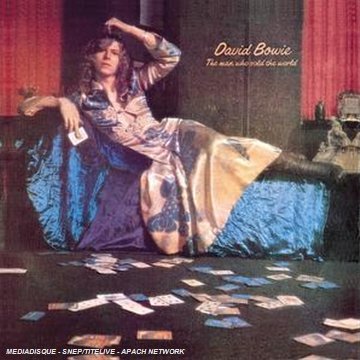
The album cover,which portays Bowie with flowing golden locks and wearing a full-length dress,is now a classic collector's item.Contrary to popular belief,the dress cover was never withdrawn from the US market because it was never actually used there in the first place.
Another interesting fact about the album is that the title was changed very late on in the day.The original title was Metrobolist.
The Man Who Sold the World also sounds so oddly formed and dark.The seeds of cyborg space-pop,later developed by the likes of the Futurists John Foxx,Gary Nauman,Bill Nelson and Thomas Dolby,are to be found on songs such as 'Saviour Machine'.The sort of childlike paranoia found on 'After All' and 'All the madmen' was a new form of Gothic melodrama,and a direct influence on Siouxsie and The Cure in the 70s and 80s,and America's Nine Inch Nails in the 90s.
Key to this bleak soundscape was Visconti and Bowie's desire to harness the newly arrived musical possibilities of the synthesizer.Visconti remembers : 'The synth was a passion of mine at the time'.


Howver,the actual recording of the album was a nightmare for the young Visconti.Accoding to Visconti,Bowie appeared distracted and undiciplined,spending more time with Angie in the lobby of the recording studio kissing,cuddling and cooing. ( 'naughty Uncle Tony says I have to do a vocal now.Bye bye Angie-wangie').Much of the music was 'arranged ' by Visconti and the band.
The album's protagonist was time and again arriving in the studio in a lyricless state,further driving the smoach-churned producer into a state of mild apoplexy.Visconti remembers : " Bowie was writing at the last minuste because (one),he wanted to,and (two) he was preocupied in the lobby of the studio with his new-found love,Angie."
The tactic of writing in the studio and coming up with lyrics for songs at the 11th hour may have fazed his friends,but Bowie was learning a new technique,which involved almost spontaneous last-minute assembly of a song's lyrical content in the studio.Bowie has never really been a concentional craftsman and,as his career progressed,he turned expediency into a tactic,developping a spontaneous creative environment.
The Man Who Sold The World worked well in artistic terms.As a commercial product,however,it was another near-fiasco,selling moderately for a while in the States,but disastrosly in the UK.Ronson went back to Hull to lvie with his parents and to work as a gardener.Moreover,shortly after the recording of the album,Visconti departed the Bowie scene to concentrate on his production work with Bolan.There was a number of reasons for Visconti quitting,but the main one was Bowie's business relationship with Defries.

____________________________________________

The Man Who Sold The World is one of my favourite albums ( you will hear this a lot from me,though!).My personal favourites are : 'All the Madmen' - I think the lyrics are phenomenal.This is one of the songs I always sing in class and annoy my classmates.The Man Who Sold The World is,lyrically,one of Bowie best works.The lyrics attracted me in the first place,and this is also one of the first Bowie songs I have heard.'Saviour Machine','She Shook Me Cold' and 'Black Country Rock' are relatively new to my "Loved Songs" section.

marți, 20 decembrie 2011

7.Look out all you rock'n'rollers,1970-1972

" We never got off on all that revolution stuff
Such a drag - too many snags "

[Mott the Hoople,"All the Young Dudes",1972,words and music by David Bowie]

And here we are!Finally we are going to speak about glam,and we have finally arrived to David's 'golden age'.

How did Bowie start the decade?Not only with his first hit single under his belt,but also with a string of commercial and artistic failures to his name,too.In 1970,he made a number of important commercial and personal decisions which would dictate the course of his career for the first half of the decade.
First,he sacked his manager,Ken Pitt;second,he 'invented' glam rock;third,he hooked up with a inexperienced rock manager but very smart businessman-lawyer named Tony Defries;and last,he decided to get angaged to his girlfriend,Angela Barnett,who for a while basket in his limelight and joined his spangled journey to stardom.

A. The Marc Bolan - David Bowie dispute

The dispute is related to who has actually started the whole glam thing off.Marc Bolan was the first to have use glitter in his 1971 Top of the Pops show,and he claims being the godfather of glam.However,what mattered most to Bolan was stardom at any cost.Tony Visconti says: "Marc's weakness was his sense that he had 'arrived',and he never developed himself as a musician beyond the stage he was at during his hit-single years.He also got caught liying too many times - he felt he could sau anything to manipulate journalists.His tall tales were legend!David never shared any of Marc's weaknesses".Marc was less of a diplomat than Bowie,and tended to piss people off more easily.
In many respects,Bolan paved the way for Bowie.Bowie himself wrote in 1998: " The little imp opened the door".
Both had ploughed similar furrows in the late 1960s.Both were from a folk-pop base,but Bolan made the transition from minority acoustic elfin cult artist to mainstream - rogering pop god first.Bowie followed,doing it better,and taking it further,but Bolan had opened the door.


B. The Glam Era

Calling it a glam "movement" is a bit of a misnomer as it implies a sort of united front.There were far too few American bands to actually even form a glam-rock scene over there.A scene did exist centred around the Warhol crowd in New York in 1970/71,an absrudist movement concerned not so much with music,but with theatre and film.
Very broadly speaking,there were always two wings of glam,or "glitter" rock as it was more referred to at the time:

a)there was the arty,serious,more subversive end :
- David Bowie
- Roxy Music
- The New York Dolls
- Alice Cooper
- Lou Reed ( for a time )

b)then,there were the lads in silly trousers
- Gary Glitter
- Sweet
- Alvin Stardust


With the exception of Suzi Quatro( this girl is amazing,you should try some of her songs,esspecially Stumbulin' In,with Chrish Norman),glam was almost overwhelmingly male as well as overwhelmingly heterosexual.Despite all the limp-wristedness,few of the glam-rock acts were actually gay.Elton John 'came out' in 1976,well after the high-water mark of the glam-rock movement.For the first half of the 70s,Elton was at pains to hide his homosexuality from the media and his fans.Lou Reed,whose bisexuality was an obvious factor,stayed on the glam bandgagon for one album only.
No,UK glam rock was unremittigly male and laddish,despite the make-up and posing.Gary Glitter was the "leader of the gang".The Sweet,too,were all lads together,'hell raising' on a 'teenage rampage',while Slade ( this guys are also gorgeous,try 'Far Far Away')the boozing Midlands skinheads-turned-glitter-freaks,and probably the best of glam pop bands at the time,also demonstrated their impeccably laddish credentials by misspelling their half dozen hits ( Far Far Away is an amazing song,listen to it :D ).
But you had to have real nerve to be,or indeed even to look like,David Bowie.He soon had a community of fans who dared to be different and who ,as we shall see,were a ace apart from the rest of the glam-rock fans.
In general,Bowie was dismissive of most of the competition,although Alice Cooper (with School's Out for Summer),Elton John and Rod Stewart and The Faces were releasing very strong material in 1972 and 1973.Bowie's competition with Bolan was a feature of the 'glam wats' during the period.One of the few contemporary acts Bowie had any time for would appear to have been Roxy Music.Some critics consider Roxy Music and possibly Steve Harley and Cockney Rebel as the only true glam-rock bands in that they actually started their professional careers as glam or art-rock acts,rather than twiddly folkies.
The glam era was possibly the last big male-band era in UK pop:

- Gary Glitter ( 3 nr 1s,4 nr 2s) VS Sweet ( 1 nr 1, 4 nr 2s) VS Slade (6.1,3.2) VS T-Rex ( 4.1,4.2) VS Wizzard (2.1)

This was an intensely competitive period.That's why the Oasis VS Blur face-off in 1995,when the two Britpop acts schedueled their single relaes for the same day,was important.


So,what was glam rock all about?Was it simply,as John Lennon once put pit "just rock'n'roll with lipstick on'?
Glam rock definitely had a more show-business side,in form of the often fun Gary Glitter and the hardly ever fun Alvin Stardust.
The Bowie version of glam was as much to do with the floutinf of gender codes and injecting a certain artiness and detachement into popular music as with attempts to shock the masses in the era of hippy,joss-stick-tingled stupefaction.Its origins are to be found in figures such as Little Richard,whose stage persona was flamboyantly garish and androginous.
Syd Barrett,the first of the 60s psychedelic performers to wear make-up and an acknowledged influence on Bowie in particular.Before his collapse into mental illness,Barrett briefly promised an alarming future for pop,a future full of space-out tripping and flaunted convention.Barrett prefigured Bowie's space-age fascination wish songs such as 'Interstellar Overdrive','Astromine Domine','Arnold Layne'.Had Barrett continued,there might have been less room for Bowie to manoeuvre in the 1970s.But he didin't.By the earlt 1970s,he was,very sadly,a comatose wreck,pop's most famous acid casualty;an innovator destroyed before his prime.
In the hands of Bowie,glam challenged pop's masculine ethos.Bowie's version of glam was about gender violence.Lou Reed and Iggy Pop only started to wear obtrusive make-up on stage once Bowie and Bolan had begun to do so.
Soon,every self-respecting British teen band to have at least one of its members kitted out in a fake leopard-skin jumpsuit with assorted glittery attachements.Bowie,however,had very little to do with these glitter rockers.

Hype

The origins of glam,Bowie-style,can be traced back to the very first months of the 70s.At the Roundhouse in London,in February 1970,Bowie and his band,Hype,played one of the most significant and most indifferently received concerts in rock history.
Hype were intended as a cartoonesque caper,a sort of rock'n'roll pantomime for the new decade,and the name was intended to run counter hippy-era notions of an anti-commercialistic rock community.Bowie was Rainbow Man,wearing a cape of many colours and lots of diaphanous scarves.Drummer John Cambridge was Cowboy Man,Mick Ronson on lead guitar was Gangster Man,wearing a borrowed gold lame suit from Bowie,and bassist Tony Visconti was Hype Man,a kind of comic-book superhero.
Bowie is in no doubt that this was the first British glam-rock gig.Marc Bolan-in an attempt to get into the theatricality of the project- stood at the foot of the stage wearing a child's plastic Roman breastplate.
Tony Visconti,about the concert: " I think that is the night that the germ of glam rock was born "


David Bowie and Mick Ronson


Ronson was a very important musical component in the Bowie sound at the time.
Visconti remembers him as charming,but adds: "He always looked a bit lost;he hardly had an ambitious bone in his body."
Gus Dungeon also remembers Ronno with great affection: "He was also an utterly charming fellow,I mean,just a total sweetheart and desperately embarassed at having to pull all those stunts every night during the Ziggy period.He hated doing it.He was very shy."


David Bowie and Angela

Bowie was also by now a married man.On 20 March 1970,he and Angie were wed at Beckenham Registry Office.Angie was dressed in a second hand,purple and pink,floral silk dress bought the day before.David wore tight leather trousers,black satin shirt and Afghan coat,cut something of an unconventional dash for the wedding day.Instead of rings they exchaned Peruvian bangles during the brief ceremony.The night before their wedding was spent in bed with a mutual friend.The night after was spent down the pub getting blasted.

 Angela acted as a behind-the-scenes promoter of her husband's talents,persuading and pressurising record companies and pluggers,helping with the costumes,making phone calls,suggesting ideas,entertaining friends,listening to Bowie's work-in-progress.
 She was also into outrage and bisexuality in a big way;her hair was often shorter,spikier and punkier than her husband's.
 Many contemporaries are at pains to poit out that Bowie only really weirdified his image after living with Angie.Before the Angie years,Bowie was actually fairly quiet as an individual and had not yet discovered the flair for sartorial flamboyance we now assosicate with him.
 Angiw would constantly encourage Bowie to try on new,and ever weider,designs.


 Bowie and Angie always had a love\hate relationship.Manager Ken Pitt apparently strongly disliked her.Gud Dudgeon didin't get Angie either : " I thought she was just a typical groupie.I just thought she was really loud and full of crap and I still do."
Ken Scott says about her: "She was very flamboyant.When she walked into a room,you knew it.Musically she had no influence whatsoever.She would stop by the studio once in a while with a 'Hello,dahlings!Oh,that's lovely,yes!' and then go out and so some more shopping or something.But she was fine.I had no problems with her"

According to Angie's second biography,Bowie was quite upfront about his feelings.He told her back in 1969 that he didn't really love her,and if they married it would be something of a marriage of convenience.'Their relationship,though,was weird;supposedly an "open relationship"' says Scott 'But every time I've heard of that,it always ends up with someone jealous,and that's what eventually happened.'

Tony Visconti says about Angie: "She was there for him in a difficult transitional period.But I could see when this wasn't enough for her.At one concert David was surrounded by fans and Angie was next to him dressed even more outrageously than he was (her breasts were visible).Since all the attention was on him,she feigned fainting (something she did often) and suddently she created an emergency drama around herself,taking the limelight away from David."

For a while tough,everyone was a big happy family.Bowie and Angie had soon turned their home into something of a sex-and-style laboratory,picking up blokes and girls from venues such as gay disco The Sombrero,a nigh-spot frequented by Bowie mainly as a way to get a hit of the flamboyance of gay style.
Visconti remembers moving in with his wife Liz,at Bowie and Angie's place. " Bowie was the only one among us who had any money.[...] As for wild sex - it only happened occasionally.David and Angela never tried to invove us in their sexcapades"

The Haddon Hall (their house) was apparently haunted,and Bowie spent some of the most creative years of his life there,tapping into the eerie vibe of this rambling Victorian mansion.
It was in this spooky mansion that Bowie and Angie set about starting a family of their own.By the end of the summer of 1970,Angie was pregnant.