Se afișează postările cu eticheta soul. Afișați toate postările

marți, 21 februarie 2012

20. The Gouster

   A. Carlos Alamar   
        Bowie had already made before several attempts to crack the States,but he was far from being a household name.
       Bowie loved the contemporary black music of the day, and was also intrigued by the Latin emanating from the clubs of New York, obviously being tired of the rock scene.
       In spring 1974 Bowie met a man who would act as his guide to black music, and would also be his band leader for the next 14 years: Carlos Alomar, a New Yorker of Puerto Rican extraction.


       Alomar was good-humoured, calm, jokey and light. He was the bridge between Bowie's pop/rock glam phase and the 'plastic soul' of the mid- 1970s. To Alomar, back in 73-74, Bowie was an alarming creature to behold: " When you see a man so nasty white with red hair, don't you think that's strange? The glam rock that he was known for was a completely different circle than that he was putting himself into. I told him: " What you need to do is to come to my house and my wife can make you some nice chicken and rice and beans and put some meat on those bones! " And surprisingly, he said: " Sure".
       Alomar was less than impressed with Tony Defries : " He was extremely intimidating. Defries was not fun. Defries was a guy who would try to pull the wool over your eyes. He was also non-moving. He was not giving in any negotiation. I didn't like Tony Defries at all. "

B. Corinne Schwab

       Bowie would also then meet his future personal assistant - Corinne Schwab ( known as Coco) . The two are still together in a professional capacity over 30 years later.


       With Angie back in London, enjoying the glitterati of the Chelsea scene with the aid of PMA ( a drug also known as Pamela), Bowie turned to Coco for both friendship and help. At this time, 1974, Bowie's coke addiction was worsening. Bowie's drug use became very excessive very quickly. Drugs were somehow fashionable rather than a real need. Coco was Bowie's nurse, Bowie even dedicated her a song in 1987, Never Let Me Down . She proved an extremely competent charge d'affaires, who did in fact help keep him alive during those days of coke - driven paranoia.  Tony Visconti remembers: " Coco has been a very loyal, competent assistant to David. She was well educated and multilingual, and she simply did her job very well. ".
       Slowly, but surely Coco began taking on more and more responsibilities. One of David Bowie's insiders put it like this: " Her whole life revolves around David Bowie's affairs and it's a full-time job. She never seems to have anything outside going on much". 


C. Making David Bowie a star


       Tony Defries was committed to his artist. He was determined to make Bowie a superstar in America, and within 6 months, he had succeeded. The first stage was promoting the Diamond Dogs Tour in the spring of 1974, by TV and radio commercials,Billboards,and so on. The second stage of MainMain's "Operation Bowie" was,of course, the tour itself. The Diamond Dogs tour turned out to be the most theatrical rock tour ever mounted. In fact,in its daring and visual audacity, it has probably never been rivalled since.
       This was basically a one-man show ( the main character is Halloween Jack) , with just two dancers, Guy Andrisano and Warren Peace, to provide on-stage action. During the shows the two dancers, who doubled as backing vocals, lassoed Bowie. For Time ,Bowie sang enclosed in a gigantic hand, which opened as the song started. For Sweet Thing  he sang atop a bridge , whilst,for Space oddity he seemed to have discovered the gift of flight. Hunger City, a crumbling post-nuclear holocaust city with atomic bomb-blasted skyscrapers of molten steel, would be recreated at huge expense for an astonished public.


       Bowie planned a film version of the album, but the plan was never realised. " Diamond Dogs is the last rock'n'roll group " Tony Visconti told Radio 1 in 1976: " In one version of the song, the dogs actually eat people, or they kill people on stage, or they shoot machine guns back into the audience. He has these horrible visions of the apocalypse, the end of civilisation as we know it" . 
       It was Bowie's most difficult performance to date. The ability to project both a technically proficient and engaging vocal was more important than ever, and around this time Bowie developed a new, richer, full-throated vibrato.
       Another change in the band was the replacement of Mick Ronson with Earl Slick. He was brought to Bowie's attention through Michael Kamen, the Bowie's tour musical director, who had worked with Slick previously. Although Slick was delighted with the gig, he was less than delighted with the money offer : "I took the shitty money - $300 a week. The money was disappointing. I was making more money playing bars at the time". 
       
       The tour opened on 14 June at the Montreal Forum, Canada. There then followed a gruelling 37 shows in 27 days with one day off and one matinee performance in Toronto. Following a road accident after the gig performance in Atlanta, the tour continued with only half of 'Hunger City' , as the set had been damaged.

       He was sued by some members of his band because of the low money they received. Bowie himself was having massive financial problems of his own. He found out in July, much to his utter horror, that he did not,in fact, own half of MainMan, as he had thought all along, and that his stake in the whole Defriesian empire amounted to a pittance . It's important to mention that Bowie was financing the tour out of his own income.
       Tony Visconti says:  "I don't know how Mainman worked. I wasn't part of it,except that they had more employees than they needed and lots of the running costs were charged to David,not Defries. this is what ended their working relationship. "

duminică, 12 februarie 2012

19.Diamond Dogs


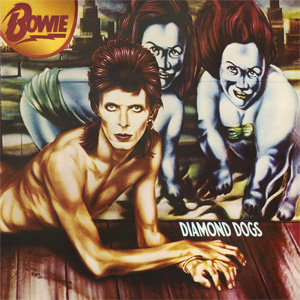
         Diamond Dogs , recorded in late 1973 and early 1974, shows him at both most indulgent and his most creative.
         Although never really a critics' rave, the album remains one of those most admired by his hard-core following. It is the closest Bowie has ever come to the ideal of a totally theatrical pop music. Martin Kirkup commented: " Where Aladdin Sane seemed like a series of Instamatic snapshots taken from weird angles, Diamond Dogs has all the deeper colours. "
         With this album, Bowie proved that without Ken Scott,without Ronno and The Spiders, he was still able to produce work of real quality.
         Diamond Dogs was also important in that it saw him working again with then ex-chum Tony Visconti.
         During the time Visconti was concentrating on Bolan, he was watching Bowie's career unfolding : "Hunky Dory made me jealous. I had nothing to do with it, but I asked myself, Where were the songs like that when I was producing him?"
         The themes of urban decay, decadence and the apocalypse, which are the main ideas on the album, are given a psychosexual twist. He envisaged a world in which snaggle-toothed ragamuffins dressed in looted furs and diamonds took over the city. The principal character, Halloween Jack, and his gang live on top of deserted skyscrapers and travel around the city on roller-skates. Bowie says he drew inspiration for the characters of 'Hunger City' from a story told to him by his father, who worked for many years for Dr Barnado's. 

Tracks:

Side one
  1. "Future Legend" – 1:05
  2. "Diamond Dogs" – 5:56
  3. "Sweet Thing" – 3:39
  4. "Candidate" – 2:40
  5. "Sweet Thing (reprise)" – 2:31
  6. "Rebel Rebel" – 4:30
Side two
  1. "Rock 'n' Roll with Me" (lyrics: Bowie, music: Bowie, Warren Peace) – 4:00
  2. "We Are the Dead" – 4:58
  3. "1984" – 3:27
  4. "Big Brother" – 3:21
  5. "Chant of the Ever Circling Skeletal Family" – 2:00

         The album begins with the track ' Future Legend', a spoken narrative describing a future urban apocalypse. It is a portrait of a city environment on the point of collapse, and its view of a dehumanised humanity, are indicators of Burroughs' influence.


         Diamond Dogs  is a trip into grotesquerry and seedy lowlife. The title track references Tod Browning, the maker of the then banned 1932 film Freaks, one of the most controversial movies ever made,starring, as it did, men and women with real-life deformities and rare medical conditions.


         The underrated 'We Are The Dead", with its creepy electric - piano opening, funeral pace and house-of-horrors imagery, is likewise graphically Gothic.  But it's the brazen drug-referencing that is most evident: "Is it nice in your snow-storm, freezing your brain? "


         In fact "Sweet Thing/Candidate/Sweet Thing (reprise)" is the real masterpiece of the album, and it's also my favourite track from the album (in fact,I'm not sure,I love the whole album). It's in moments like this, rather than in the big hit singles or the radio-friendly songs, that Bowie's reputation as a true pop genius resides.


        For '1984' , Alan Parker plays a brilliant Shaft-inspired riff, as Bowie warns "Beware the savage jaw/Of 1984"


        The ending of the album is also quite brilliant. "Big Brother",replete with fake horns, strummed guitar and a massive wall of sound builds an  astonishingly overwrought climax which echoes some of Bowie's earlier work on The Man Who Sold The World .


        Then the song dissolves into the astonishing "Chant of the Ever-Circling Skeletal Family", a truly mesmeric and frightening chant in five/four time . It's on of the greatest moments Bowie has ever committed to tape.


        Aside from these moments of grand experimentation in sonics and theatricality, Diamond Dogs also contained two of Bowie's best ever pop songs:  " Rock'n'Roll With Me", the single that never was,pointed, ever so slightly, towards the more soulful future that would be The Young Americans period.


        And then, there's rebel rebel , which reached a surprisingly lowly Number 5 after crashing into the Top 40 once place below that in the first week of release. The last of his bona fide glam singles, it was a manifesto for all the Bowie Boys and Bowie Girls: " You got your mother in a whirl  / She;s not sure if you're a boy or a girl" sums up early -70s gender-bending perfectly. Arguably Bowie's greatest-ever riff, it was a brilliant taster for the album proper.
        Bowie performed the new single on the Dutch Show Top Pop in February,whilst in Holland for a few days to work on the new album at a studio in Hilversum. With an added eye patch ( he had gone down with a bout of conjunctivitis), the Aladdin Sane meets pirate man look was the last time we would see the full crimson spiky Bowie haircut  ( if I were to choose,I'd say this is one of Bowie's sexiest videos.I love his hair here)


        The cover presents Bowie half-man/half-dog,and it;s one of Bowie;s most dramatic, and definitely most seedy covers ( made by the Belgian artist Guy Peellaert)
        Diamond Dogs brought the first phase of Bowie's career to an end. Released in April 1974, Diamond Dogs not only closed down Bowie's glam-rock period, but became glam-rock's epitaph.

        When he left the UK for the US in April 1974, the version of him on show was, on first inspection, a sartorially toned-down representation. The era of glitter and stack-heeled boots was indeed over,but the man himself was entering the most paranoid and out-there period of his life,a three-year period of chill, supercharged creativity. He redesigned his Ziggy cut into an epic flame-coloured parting,packed away the kabuki garb and reinvented himself as a sharply dressed soul boy in a suit. The gouster was born.


18. 1973 - Bowie's year

             By 1973 there was a recognisable Bowie cult in the UK, as 'Bowie Boys' and ' Bowie Girls' roamed suburbia.
             Although Bowie's records were being bought by everyone from teens to mums and dads, his hard-core following, those that actually took to the streets in make-up and glitter,seemed to consist of two types:

  • first, Bowie had a huge following among teenage girls
  • second, there were those arty suburbanites, the sexual experimenters, the bedsit gloomsters, who were drawn to Bowie's cleverness and his love for arty cross-referencing.
             Scientologist and writer, Simon Frith, wrote: " Bowie-ism was a way of life - style as meaning - and no other idol has had such an intense influence on his fans as David Bowie. His example of self- creation was serious and playful - image as art as image, and his tastes, the selves he created, were impeccably suburban: he read romantic literature ; he was obsessively, narcissistically, self-effacing....Bowie was youth culture not as collective hedonism but as individual grace that showed up everyone else as clods." In fact, Firth points out : "As a star, Bowie never pretended to "represent" his fans, but he did make available to those fans a way of being a "star"...Glam rock dissolved the star/fan division not by stars becoming one of the lads, but by the lads becoming their own stars. " 
             In May 1973 there was made a documentary by Bernard Falk - the programme recorded scenes of mass hysteria, screaming teenies and boys and girls dyed hair, glitter and the modish Aladdin Sane thunderbolt felt-tipped across their faces. This was the beginning of Bowie's immortality through style, and ,for his fans , it was this sense of sartorial danger which magnetised them.
             Bowie was freakish and other, and he presented the blueprint for all those bored suburbanites. Bowie, with his brand of self-absorption, his anti- countercultural poses and his revelry  in the surface trappings of glitz and artificiality, was the supreme expression of this new era of post- hippy, pre-punk questioning.
             By the end of 1973, Bowie had extricated himself from The Spiders and was about to bring his professional relationship with both Mick Ronson and Ken Scott to an end.
             'The 1980 Floor Show" was the last time Ronson and Bowie would share a stage for 10 years.
             The end of Bowie's working relationship with Ken Scott meant a shift of focus to more experimental techniques and arguably greater musical daring, and an end to the 'classic' pop period of David Bowie.
             Without question, 1973 will go down in history as Bowie's year. On New Year's Eve, RCA presented Bowie with a plaque to commemorate having 5 different albums in the chart simultaneously for a 19 - week period. RCA announced that his total UK sales were now 1.056.400 albums and 1.024.068 singles.
             Around this period, David would meet Ava Cherry - a striking black woman with short,platinum-blonde curls, perhaps several inches taller than Bowie himself. Bowie had met Ava in New York at the time of his Radio City Music Hall gigs in February 1973. Ava was a waitress at a party and Bowie soon had her earmarked as a future singing star. Cherry would now also be a regular backing singer for Bowie, and thee two would be romantically linked.

             Bowie's musical obsession were changing, and changing fast. What is certain is that, by the end of 1973, Bowie was already on the road to a more soul-inflected future.