Se afișează postările cu eticheta glam. Afișați toate postările

duminică, 12 februarie 2012

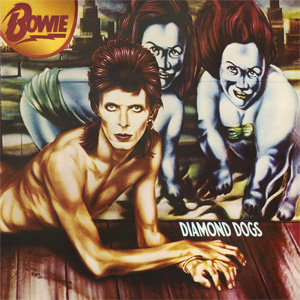
19.Diamond Dogs


         Diamond Dogs , recorded in late 1973 and early 1974, shows him at both most indulgent and his most creative.
         Although never really a critics' rave, the album remains one of those most admired by his hard-core following. It is the closest Bowie has ever come to the ideal of a totally theatrical pop music. Martin Kirkup commented: " Where Aladdin Sane seemed like a series of Instamatic snapshots taken from weird angles, Diamond Dogs has all the deeper colours. "
         With this album, Bowie proved that without Ken Scott,without Ronno and The Spiders, he was still able to produce work of real quality.
         Diamond Dogs was also important in that it saw him working again with then ex-chum Tony Visconti.
         During the time Visconti was concentrating on Bolan, he was watching Bowie's career unfolding : "Hunky Dory made me jealous. I had nothing to do with it, but I asked myself, Where were the songs like that when I was producing him?"
         The themes of urban decay, decadence and the apocalypse, which are the main ideas on the album, are given a psychosexual twist. He envisaged a world in which snaggle-toothed ragamuffins dressed in looted furs and diamonds took over the city. The principal character, Halloween Jack, and his gang live on top of deserted skyscrapers and travel around the city on roller-skates. Bowie says he drew inspiration for the characters of 'Hunger City' from a story told to him by his father, who worked for many years for Dr Barnado's. 

Tracks:

Side one
  1. "Future Legend" – 1:05
  2. "Diamond Dogs" – 5:56
  3. "Sweet Thing" – 3:39
  4. "Candidate" – 2:40
  5. "Sweet Thing (reprise)" – 2:31
  6. "Rebel Rebel" – 4:30
Side two
  1. "Rock 'n' Roll with Me" (lyrics: Bowie, music: Bowie, Warren Peace) – 4:00
  2. "We Are the Dead" – 4:58
  3. "1984" – 3:27
  4. "Big Brother" – 3:21
  5. "Chant of the Ever Circling Skeletal Family" – 2:00

         The album begins with the track ' Future Legend', a spoken narrative describing a future urban apocalypse. It is a portrait of a city environment on the point of collapse, and its view of a dehumanised humanity, are indicators of Burroughs' influence.


         Diamond Dogs  is a trip into grotesquerry and seedy lowlife. The title track references Tod Browning, the maker of the then banned 1932 film Freaks, one of the most controversial movies ever made,starring, as it did, men and women with real-life deformities and rare medical conditions.


         The underrated 'We Are The Dead", with its creepy electric - piano opening, funeral pace and house-of-horrors imagery, is likewise graphically Gothic.  But it's the brazen drug-referencing that is most evident: "Is it nice in your snow-storm, freezing your brain? "


         In fact "Sweet Thing/Candidate/Sweet Thing (reprise)" is the real masterpiece of the album, and it's also my favourite track from the album (in fact,I'm not sure,I love the whole album). It's in moments like this, rather than in the big hit singles or the radio-friendly songs, that Bowie's reputation as a true pop genius resides.


        For '1984' , Alan Parker plays a brilliant Shaft-inspired riff, as Bowie warns "Beware the savage jaw/Of 1984"


        The ending of the album is also quite brilliant. "Big Brother",replete with fake horns, strummed guitar and a massive wall of sound builds an  astonishingly overwrought climax which echoes some of Bowie's earlier work on The Man Who Sold The World .


        Then the song dissolves into the astonishing "Chant of the Ever-Circling Skeletal Family", a truly mesmeric and frightening chant in five/four time . It's on of the greatest moments Bowie has ever committed to tape.


        Aside from these moments of grand experimentation in sonics and theatricality, Diamond Dogs also contained two of Bowie's best ever pop songs:  " Rock'n'Roll With Me", the single that never was,pointed, ever so slightly, towards the more soulful future that would be The Young Americans period.


        And then, there's rebel rebel , which reached a surprisingly lowly Number 5 after crashing into the Top 40 once place below that in the first week of release. The last of his bona fide glam singles, it was a manifesto for all the Bowie Boys and Bowie Girls: " You got your mother in a whirl  / She;s not sure if you're a boy or a girl" sums up early -70s gender-bending perfectly. Arguably Bowie's greatest-ever riff, it was a brilliant taster for the album proper.
        Bowie performed the new single on the Dutch Show Top Pop in February,whilst in Holland for a few days to work on the new album at a studio in Hilversum. With an added eye patch ( he had gone down with a bout of conjunctivitis), the Aladdin Sane meets pirate man look was the last time we would see the full crimson spiky Bowie haircut  ( if I were to choose,I'd say this is one of Bowie's sexiest videos.I love his hair here)


        The cover presents Bowie half-man/half-dog,and it;s one of Bowie;s most dramatic, and definitely most seedy covers ( made by the Belgian artist Guy Peellaert)
        Diamond Dogs brought the first phase of Bowie's career to an end. Released in April 1974, Diamond Dogs not only closed down Bowie's glam-rock period, but became glam-rock's epitaph.

        When he left the UK for the US in April 1974, the version of him on show was, on first inspection, a sartorially toned-down representation. The era of glitter and stack-heeled boots was indeed over,but the man himself was entering the most paranoid and out-there period of his life,a three-year period of chill, supercharged creativity. He redesigned his Ziggy cut into an epic flame-coloured parting,packed away the kabuki garb and reinvented himself as a sharply dressed soul boy in a suit. The gouster was born.


15. Aladdin Sane


           Aladdin Sane has always been regarded as Ziggy's slightly inferior companion piece. Written in the main on tour in the States during the latter part of 1972, and released in the April of the following year, it was very much 'Ziggy goes to America' ,and English stylisation of American sounds, ideas and images.
            Aladdin Sane represented a definite step towards a harder, punchier sound. "It was almost like a treading-water album . But funnily enough, in retrospect, for me, it's the more successful album, because it's more informed about rock ' n' roll than Ziggy was", remembers Bowie.
            The Aladdin Sane character itself was a schizoid amalgamation, and the music reflected this fracturing down. Kent Scott remembers that,at the time, Bowie's own personality was undergoing series of quick- fire changes.
            Most of the Aladdin Sane album was written on the road during the autumn of 1972. Bowie himself was unsure of what direction to go in : " I kind of knew that I had said all that I could say about Ziggy, and what I'd end up doing would be "Ziggy Part 2"
            Speaking in 1993, Bowie told the BBC about the mythic quality America had at the time: " I don' know how much of a culture shock it is now....But I think for us back then, going to America was it. It used to blow us away. It was our own language, but it was this other world... Suddenly my songs didn't seem so out of place. "
            As with Ziggy Stardust , the cover shot for the album was as stylish as it contents. The album cover, a head-and-shoulder shot of Bowie with hair dyed reddish-orange and a painted thunderbolt splitting his face in two, is one of the most eye-catching and alarming ever made. The divine thunderbolt hinted at Bowie's continued fascination with the deification of pop idols. It split the face, and by implication the psyche , in two. Bowie didn't look like anything resembling a human being at all. The shot turned his physiognomy into a sort of tribal death mask, a shaman for the 1970s. When the album hit the shops in the spring of 1973, the cover was as startling  as rock  cover ever got.

Track list:


Side one

1. "Watch That Man" 4:30
2. "Aladdin Sane 5:06
3. "Drive-In Saturday" 4:33
4. "Panic in Detroit" 4:25
5. "Cracked Actor" 3:01


Side two

6. "Time" 5:15
7. "The Prettiest Star" 3:31
8. "Let's Spend the Night Together" 3:10
9. "The Jean Genie" 4:07
10. "Lady Grinning Soul"  3:54


            Aladdin Sane was recorded in New York and London,in January 1973. ' The Jean Genie' had been recorded for single release the previous November and was remixed by Ken Scott for the album. " It was done to be a big hit...Yeah,it's cute,but it's not one of my favourites. "
            The song was, of course, a homage of sorts, as Bowie reveals : "The Jean Genie was an ode to Iggy ".
            The single became Bowie's biggest seller to date, peaking at Number 2 just after Christmas. For the single release,MainMan funded Bowie's first ever promo,which was filmed over two days in San Francisco , starring actress Cyrinda Foxe,to add,as Rock says, "some local colour".  Foxe was a famous scenester and star of Warhol's film  Bad. David Bowie was now in love with Cyrinda and Angie had a new lover,Billy Doll.


            Drive-In Saturday , the second single off the album, was vastly superior, and it and Rebel rebel  are his finest glam-era singles.

            Time is one of his most successful songs from any period + five minutes of weird perfection. In the middle section Bowie heavy breathing, brought to the fore in the mix by Ken Scott, sets up a wonderfully overwrought tension to the melodrama. In the 90s, Suede would source this sort of Bowiesque moment on tracks such as The Power and The Beautiful Ones . This was always one of Ken Scott's favourite Bowie tracks.

            The beautiful ballad Lady Grinning Sould is,for Bowie, unusually sensual. Its direct, intimate appeal and lush mix, with twelve-string guitar and almost latino piano part, provide and unusually emotional and sexual ambience.


             The pivotal song on the album,though, is the title track, the clearest indicator of how Bowie was trying to free himself from the confines of rock. Mick Garson, his new pianist, was one of the main inspirations. Garson was on board and he would remain with Bowie for the next three years. Bowie was becoming jaded with pop / rock and,in Garson, he saw a talented, eccentric musician who he could learn from. It is no surprise that Bowie's experimental phase started with Aladdin Sane .


            Another track, the opener, Watch that Man ,has baffled fans for close on three decades. The question on most people's lips has been a simple one : "where the hell is David Bowie?" . Buried beneath a wall of glam-rock freak-out, the lyric is almost inaudible.


            Cracked Actor is one of my personal favourites, I love the live variants, and the way Bowie plays his role on stage.


            Panis in Detroit has an unique sound,and expresses David Bowie's fascination with the city.


            Aladdin Sane well and truly established Bowie as a major- league pop star, in the UK at least. On its release in April 1973, it debuted at the top of the UK charts. The album was Number One for 5 weeks.


miercuri, 8 februarie 2012

13.Roxy Music and Bowie

      If Bowie was still essentially an excellent pop craftsman, then it was Roxy Music who were the avatars of change.Thematically, if not musically, there were similarities between Bowie and Roxy Music. The blast of ice nonemotion would have its disciples later in the decade (such as Gary Numan) and Marilyn Manson and Nine Inch Nail's graphic, cruel psycho-porn has its origins in the Ferry/Bowie artifice.
      Bowie and Roxy were both serious and contrived, pop and rock, jokey yet serious. Both Bowie and Ferry saw stage performance as drama and milked theatricality for all it was worth. Ferry made it an absolute prerequisite that his band looked good.
      Like Bowie, Ferry and Roxy Music delighted in the artificial.
      Bryan Ferry recalls: "Our music was not so much designed for the charts as for thinking audience. We didn't see ourselves as part of a glam-rock movement at all ... We were conscious of Marc Bolan and Bowie but we thought we were very much doing our own thing. "
      Roxy Music and Eno were actually the other side of the same coin. Bowie took from high art (such as steal from Baudelaire, or a namecheck for Jean Genet) and used it in pop ; Ferry and Eno took from un-artistic popular culture and turned it into art-pop. Whatever the spin, it made it for a thrilling musical experience.
      many critics were initially highly sceptical of them and they criticised them for almost exactly the same reasons they did Bowie. However, Roxy Music had the last laugh, of course, and eventually found themselves at Number 1 in the UK album charts late in 1973 with their third album, Stranded.


      Roxy were the only serious rivals to Bowie in the period 1972 to 1975. Although the media hype was centred on Bowie's rivalry with Bolan, in actuality it was Roxy Music who were Bowie's direct competitors. A huge number of Roxy Music fans were Bowie fans too. It's no surprise that in 1975 and 1976, when punk was breaking, many of the leading lights would declare for Bowie and Ferry, while trashing Rod and Elton.
      Bowie and Roxy kept a deliberate, watchful distance in the glam-rock era. Roxy Music played with Bowie at the Croydon Greyhound in June 1972. "He was on a roll at the time and we were just emerging. I think he asked for us to join him on tour. It was a very good audience for both turns", says Ferry.
      If with Roxy's first record we can see the beginnings of a definite rupture with the past,then conceptually,Ziggy Stardust is more important. The writer Jon savage called "Ziggy Stardust" the first post-modern pop record.


sâmbătă, 28 ianuarie 2012

12.The Rise and Fall of Ziggy Stardust and The Spiders from Mars

       Back in early 1972, Bowie, although striking, was not quite the shock of the new he would become in 1973.
       That said,the cover of his fifth, and , so many would say, greatest album, is one of rock's most iconic images.

       Work on the Ziggy Stardust album in 1972/73 also took place at Trident Studios.Bowie told Ken Scott,who had again been brought in to co-produce,that he wanted a very different sound.According to Ken Scott, however, although Bowie was keen to harden the sound, the influence of the then contemporary proto-punk sound of Iggy Pop and Lou Reed was minimal at best.

Tracks:

Side 1
1 Five Years
2 Soul Love
3.Moonage Daydream
4 Starman
5 It Ain't Easy
Side 2
1 Lady Stardust
2 Star
3 Hang On To Yourself
4 Ziggy Stardust
5 Suffragette City
6 Rock' n ' Roll Suicide

      The album has a wonderful unity,from the heartbeat-like drum intro on Five Years  to the calamitously overwrought ending of  Rock N Roll Suicide .
      If you ask me, all songs are masterpieces! My personal favourite has to be Rock n Roll suicide because of its lyrics.


      In Five Years , lyrically, Bowie strikes a deliberately unstable register, depicting a world five years from Armageddon in terms of universals or stereotypes - the priest, the soldier, the policeman, etc.. Crucially, Bowie's society in crisis deals with minorities: a black ( cast as the good guy), a gay ( who is repulsed by the priest and not the object of society's repulsion for once), a woman (out of control,downtrodden) and a physically handicapped person ( " I kiss you / You're beautiful / I want you to walk ") . Five Years  has a radical edge which helps position Bowie as a speaker for the dispossessed.


      Starman ,the second RCA single, was released on 28th April 1972,although it took until the chart for the week ending 8 July for it to hit the Top 40. The band played it on ITV's Lift Off  in front of a backdrop of huge gold stars, and on Top of the Pops  on 5th July 1972. It was these 2 television appearances in the early Summer of 1972 that were crucial in making David Bowie a star. Many fans date their conversion to all things Bowie to this Top of the Pops appearance,even myself! This was the first David Bowie video I've seen,and this was the song that convinced me to try more of Bowie,made me curious about the other songs,though I did not live in the 70s.Lavishly plastered in make-up, his hair dyed a brilliant carrot-orange,and lovingly limp arm draped round guitarist Mick Ronson's broad shoulders, a little piece of pop history was made. An event changed people's lives. Nobody had seen anything quite like it before. Enjoy it!


      The writer Jon Savage called Ziggy Stardust  the 'first post-modern pop record',and it's easy to see what's he getting at. Bowie littered the songs with allusion to real pop world.The reference in Ziggy Stardust  to Jimi Hendrix is unmissable - " He played it left hand, but made it too far " (Bowie himself,though a leftie,plays the guitar right-handed) .


      In Lady Stardust  his references are to Marc Bolan - " People stared at the make-up on his face / Laughed at his long black hair,his animal grace" . This is also one of my favourite songs from the album.


      Soul Love another beautiful song - his voice is amazing!


     Lyrically Moonage Daydream,is full of references to bisexuality and gender crossing : " I'm an alligator / I'm a mama papa commin' for you "


     Star,like Changes before it - is another brazen declaration of intent: " So inviting - so enticing to play the part / I could play the wild mutation as a rock n roll star / I could do with the money "


    Suffragette City its faster than the other songs of the album,another favourite of mine


      By thr Summer of 1972, Bowie had finally achieved UK succes, The Zigy Stardust album rocketed into the charts and was to stay there for two years.

marți, 20 decembrie 2011

7.Look out all you rock'n'rollers,1970-1972

" We never got off on all that revolution stuff
Such a drag - too many snags "

[Mott the Hoople,"All the Young Dudes",1972,words and music by David Bowie]

And here we are!Finally we are going to speak about glam,and we have finally arrived to David's 'golden age'.

How did Bowie start the decade?Not only with his first hit single under his belt,but also with a string of commercial and artistic failures to his name,too.In 1970,he made a number of important commercial and personal decisions which would dictate the course of his career for the first half of the decade.
First,he sacked his manager,Ken Pitt;second,he 'invented' glam rock;third,he hooked up with a inexperienced rock manager but very smart businessman-lawyer named Tony Defries;and last,he decided to get angaged to his girlfriend,Angela Barnett,who for a while basket in his limelight and joined his spangled journey to stardom.

A. The Marc Bolan - David Bowie dispute

The dispute is related to who has actually started the whole glam thing off.Marc Bolan was the first to have use glitter in his 1971 Top of the Pops show,and he claims being the godfather of glam.However,what mattered most to Bolan was stardom at any cost.Tony Visconti says: "Marc's weakness was his sense that he had 'arrived',and he never developed himself as a musician beyond the stage he was at during his hit-single years.He also got caught liying too many times - he felt he could sau anything to manipulate journalists.His tall tales were legend!David never shared any of Marc's weaknesses".Marc was less of a diplomat than Bowie,and tended to piss people off more easily.
In many respects,Bolan paved the way for Bowie.Bowie himself wrote in 1998: " The little imp opened the door".
Both had ploughed similar furrows in the late 1960s.Both were from a folk-pop base,but Bolan made the transition from minority acoustic elfin cult artist to mainstream - rogering pop god first.Bowie followed,doing it better,and taking it further,but Bolan had opened the door.


B. The Glam Era

Calling it a glam "movement" is a bit of a misnomer as it implies a sort of united front.There were far too few American bands to actually even form a glam-rock scene over there.A scene did exist centred around the Warhol crowd in New York in 1970/71,an absrudist movement concerned not so much with music,but with theatre and film.
Very broadly speaking,there were always two wings of glam,or "glitter" rock as it was more referred to at the time:

a)there was the arty,serious,more subversive end :
- David Bowie
- Roxy Music
- The New York Dolls
- Alice Cooper
- Lou Reed ( for a time )

b)then,there were the lads in silly trousers
- Gary Glitter
- Sweet
- Alvin Stardust


With the exception of Suzi Quatro( this girl is amazing,you should try some of her songs,esspecially Stumbulin' In,with Chrish Norman),glam was almost overwhelmingly male as well as overwhelmingly heterosexual.Despite all the limp-wristedness,few of the glam-rock acts were actually gay.Elton John 'came out' in 1976,well after the high-water mark of the glam-rock movement.For the first half of the 70s,Elton was at pains to hide his homosexuality from the media and his fans.Lou Reed,whose bisexuality was an obvious factor,stayed on the glam bandgagon for one album only.
No,UK glam rock was unremittigly male and laddish,despite the make-up and posing.Gary Glitter was the "leader of the gang".The Sweet,too,were all lads together,'hell raising' on a 'teenage rampage',while Slade ( this guys are also gorgeous,try 'Far Far Away')the boozing Midlands skinheads-turned-glitter-freaks,and probably the best of glam pop bands at the time,also demonstrated their impeccably laddish credentials by misspelling their half dozen hits ( Far Far Away is an amazing song,listen to it :D ).
But you had to have real nerve to be,or indeed even to look like,David Bowie.He soon had a community of fans who dared to be different and who ,as we shall see,were a ace apart from the rest of the glam-rock fans.
In general,Bowie was dismissive of most of the competition,although Alice Cooper (with School's Out for Summer),Elton John and Rod Stewart and The Faces were releasing very strong material in 1972 and 1973.Bowie's competition with Bolan was a feature of the 'glam wats' during the period.One of the few contemporary acts Bowie had any time for would appear to have been Roxy Music.Some critics consider Roxy Music and possibly Steve Harley and Cockney Rebel as the only true glam-rock bands in that they actually started their professional careers as glam or art-rock acts,rather than twiddly folkies.
The glam era was possibly the last big male-band era in UK pop:

- Gary Glitter ( 3 nr 1s,4 nr 2s) VS Sweet ( 1 nr 1, 4 nr 2s) VS Slade (6.1,3.2) VS T-Rex ( 4.1,4.2) VS Wizzard (2.1)

This was an intensely competitive period.That's why the Oasis VS Blur face-off in 1995,when the two Britpop acts schedueled their single relaes for the same day,was important.


So,what was glam rock all about?Was it simply,as John Lennon once put pit "just rock'n'roll with lipstick on'?
Glam rock definitely had a more show-business side,in form of the often fun Gary Glitter and the hardly ever fun Alvin Stardust.
The Bowie version of glam was as much to do with the floutinf of gender codes and injecting a certain artiness and detachement into popular music as with attempts to shock the masses in the era of hippy,joss-stick-tingled stupefaction.Its origins are to be found in figures such as Little Richard,whose stage persona was flamboyantly garish and androginous.
Syd Barrett,the first of the 60s psychedelic performers to wear make-up and an acknowledged influence on Bowie in particular.Before his collapse into mental illness,Barrett briefly promised an alarming future for pop,a future full of space-out tripping and flaunted convention.Barrett prefigured Bowie's space-age fascination wish songs such as 'Interstellar Overdrive','Astromine Domine','Arnold Layne'.Had Barrett continued,there might have been less room for Bowie to manoeuvre in the 1970s.But he didin't.By the earlt 1970s,he was,very sadly,a comatose wreck,pop's most famous acid casualty;an innovator destroyed before his prime.
In the hands of Bowie,glam challenged pop's masculine ethos.Bowie's version of glam was about gender violence.Lou Reed and Iggy Pop only started to wear obtrusive make-up on stage once Bowie and Bolan had begun to do so.
Soon,every self-respecting British teen band to have at least one of its members kitted out in a fake leopard-skin jumpsuit with assorted glittery attachements.Bowie,however,had very little to do with these glitter rockers.

Hype

The origins of glam,Bowie-style,can be traced back to the very first months of the 70s.At the Roundhouse in London,in February 1970,Bowie and his band,Hype,played one of the most significant and most indifferently received concerts in rock history.
Hype were intended as a cartoonesque caper,a sort of rock'n'roll pantomime for the new decade,and the name was intended to run counter hippy-era notions of an anti-commercialistic rock community.Bowie was Rainbow Man,wearing a cape of many colours and lots of diaphanous scarves.Drummer John Cambridge was Cowboy Man,Mick Ronson on lead guitar was Gangster Man,wearing a borrowed gold lame suit from Bowie,and bassist Tony Visconti was Hype Man,a kind of comic-book superhero.
Bowie is in no doubt that this was the first British glam-rock gig.Marc Bolan-in an attempt to get into the theatricality of the project- stood at the foot of the stage wearing a child's plastic Roman breastplate.
Tony Visconti,about the concert: " I think that is the night that the germ of glam rock was born "


David Bowie and Mick Ronson


Ronson was a very important musical component in the Bowie sound at the time.
Visconti remembers him as charming,but adds: "He always looked a bit lost;he hardly had an ambitious bone in his body."
Gus Dungeon also remembers Ronno with great affection: "He was also an utterly charming fellow,I mean,just a total sweetheart and desperately embarassed at having to pull all those stunts every night during the Ziggy period.He hated doing it.He was very shy."


David Bowie and Angela

Bowie was also by now a married man.On 20 March 1970,he and Angie were wed at Beckenham Registry Office.Angie was dressed in a second hand,purple and pink,floral silk dress bought the day before.David wore tight leather trousers,black satin shirt and Afghan coat,cut something of an unconventional dash for the wedding day.Instead of rings they exchaned Peruvian bangles during the brief ceremony.The night before their wedding was spent in bed with a mutual friend.The night after was spent down the pub getting blasted.

 Angela acted as a behind-the-scenes promoter of her husband's talents,persuading and pressurising record companies and pluggers,helping with the costumes,making phone calls,suggesting ideas,entertaining friends,listening to Bowie's work-in-progress.
 She was also into outrage and bisexuality in a big way;her hair was often shorter,spikier and punkier than her husband's.
 Many contemporaries are at pains to poit out that Bowie only really weirdified his image after living with Angie.Before the Angie years,Bowie was actually fairly quiet as an individual and had not yet discovered the flair for sartorial flamboyance we now assosicate with him.
 Angiw would constantly encourage Bowie to try on new,and ever weider,designs.


 Bowie and Angie always had a love\hate relationship.Manager Ken Pitt apparently strongly disliked her.Gud Dudgeon didin't get Angie either : " I thought she was just a typical groupie.I just thought she was really loud and full of crap and I still do."
Ken Scott says about her: "She was very flamboyant.When she walked into a room,you knew it.Musically she had no influence whatsoever.She would stop by the studio once in a while with a 'Hello,dahlings!Oh,that's lovely,yes!' and then go out and so some more shopping or something.But she was fine.I had no problems with her"

According to Angie's second biography,Bowie was quite upfront about his feelings.He told her back in 1969 that he didn't really love her,and if they married it would be something of a marriage of convenience.'Their relationship,though,was weird;supposedly an "open relationship"' says Scott 'But every time I've heard of that,it always ends up with someone jealous,and that's what eventually happened.'

Tony Visconti says about Angie: "She was there for him in a difficult transitional period.But I could see when this wasn't enough for her.At one concert David was surrounded by fans and Angie was next to him dressed even more outrageously than he was (her breasts were visible).Since all the attention was on him,she feigned fainting (something she did often) and suddently she created an emergency drama around herself,taking the limelight away from David."

For a while tough,everyone was a big happy family.Bowie and Angie had soon turned their home into something of a sex-and-style laboratory,picking up blokes and girls from venues such as gay disco The Sombrero,a nigh-spot frequented by Bowie mainly as a way to get a hit of the flamboyance of gay style.
Visconti remembers moving in with his wife Liz,at Bowie and Angie's place. " Bowie was the only one among us who had any money.[...] As for wild sex - it only happened occasionally.David and Angela never tried to invove us in their sexcapades"

The Haddon Hall (their house) was apparently haunted,and Bowie spent some of the most creative years of his life there,tapping into the eerie vibe of this rambling Victorian mansion.
It was in this spooky mansion that Bowie and Angie set about starting a family of their own.By the end of the summer of 1970,Angie was pregnant.
1.Uncage the colours

"Bowie was never meant to be.He's like a Lego kit.I'm convinced I wouldn't like him,because he's too vacuous and undisciplined.There is no definitive David Bowie"
( David Bowie on David Bowie,1976)

This is how the books starts.It seems that the real David Robert Jones is very different from his artistic ego,thing that I'm about to find out in this book.
David Bowie is one of the most photographed,adored,imitated,admired and talked-about rock star of the post-Beatles period.He is the one that invented character-playing in pop,marrying theatre and popular music in one seamless,powerful whole.He virtually defined the ways in which pop and video could be combined,with a series of stunningle inventive videos.
In the UK he was perhaps the most written-about pop star of his age.He was serios and trashy,manipulative and manipulated,and ( for a time at least) both man and woman.

Bowie had a great hold on young people's lives in the UK arguably for longer than any other pop star living or dead,longer even than The Beatless.Between 1972 and 1983,Bowie wasn't simply liked or admired - in the UK at least,he was almost worshipped.For every teenager who considered him or herself unfinished,who was not quite happy with his or her lot,who didn't like the way the society worked but couldn't articulate that sense of disquiet,Bowie was the perfect foil.It's no wonder that so many punks were originally Bowie fans.For those unsure about their sexuality or who were in agonies about "coming out",Bowie at least let them know that someone was listening : " You got your mother in a whirl\She's not sure if you're a boy or a girl" - 'Rebel Rebel',1974 .
Through such simple words,Bowie changed people's lives.For all those who felt lost,disenfranchised,alone or sad,Bowie acted out pop therapy: " Your not alone..Give me your hands,'Cos you're wonderful: - 'Rock'n'Roll Suicide,1972.

Singers and bands influenced by David Bowie:
  • had a powerful impact on punk : Siouxsie Sioux,Billy Idol were David Bowie fans. Johnny Rotten,who hated David Bowie,borrowed his haircut,while Sid Vicious was a Bowie casualty first,rock casualty second
  • Bunnyman Ian McCulloch
  • Holly Johnson
  • Boy George
  • Morrisey
  • Kate Bush (who borrowed his mime tutor,Linsday Kemp)
  • Gary Numan ( who borrowed Bowie's light show,sang froid and sneer)
  • the whole new romantic scene,the slicked back soulsters of the New Pop era ( ABC,Associates,Spandau Ballet)
  • the synth-pop duos ( Soft Cell,Pet Shop Boys,The Eurythmics)
  • in America,the 3 biggest pop icons of the 1980 : Madonna,Prince and Michael Jackson were hugely indebted to Bowie's sly shape-chnaging (Madonna dates her conversion to actually wanting to be a star to a Ziggy concert she attended at the age of fifteen)
  • in the 90s,UK groups as Suede (a neat rearticulation of Ziggy-era kitchen-sink gender-bending)
  • American bands such as Nine Inch Nails,Nirvana,The Smashing Pumpkins and Marylin Manson
  • Oasis ( in 1997,Oasis enjoyed a UK Top 3 hit - Stand by me - with a chours which echoes Bowie's ' All the Young Dudes '
  • Blur (Bowie parody/homepage,M.O.R.)
  • Supergrass ('Pumping On Your Stereo' - is a slice of 'Rebel Rebel' dosed riff rock)
  • U2
In the Noughties,it's now cool to say you love David Bowie,and everyone and his dog claims to be at least partly desended from the original Diamond Dog.

That Bowie had such an effect on fellow musicians is hardly surprising.His recordings amount to a stunning body of work: rich,exciting,fun,mysterious and deeply moving,encompassing pop,ambient,rock,soul,jazz,folk,techno,jungle ( in 1997 he even performed a country-and-western version of ' Scary Monsters ' in the States).Bowie offered the paradigmatic proof that fleet-footed changes of image and music,packaged well and presented impeccably,were the perfect receipe for career longevity.Smart,shrewd,sexy and immensely talented,Bowie prooved that to stay ahead,to stay vital,it was necessary to change.
Bowie wasn't quite original to be a true academic or intellectual (like Eno),he wasn't somehow authentic enough to be an all-out rocker (like Jagger)and he was too masculine to be an all-out drag queen ( like Wayne County).He was ,and remains,the perfect liminal pop star,an utterly convincing media re-enactment of our times,deep and serious yet frivolous and lightweight.

Though,the middle-aged dad,the everyday sleeping,eating,breathing,living David Robert Jones,is known by very,very few.David Bowie himself is largely a media monster,the greatest rock persona ever created,and only tangentially part of the personality of David Jones himself.Bowie has made camouflage and misinformation part of his actual art.


*I'd like to mention that this is my first post written in English.I hope I did it well.