Se afișează postările cu eticheta Defries. Afișați toate postările

duminică, 12 februarie 2012

16.Killing the Kabuki Monster

             As the Ziggy tour morphed into the Aladdin Sane tour in early 1973, the shows became even more ambitious.
             By the middle of 1973, Bowie had been on the road, almost non-stop, for 18 months, in a punishing schedule that included six British tours, two American tours and a tour of Japan - more than 170 gigs in all. The Japanese tour was also a huge success. At the start of the tour, Bowie was a virtual unknown with negligible record sales ; by the end, it was mass hysteria at the concerts.
             After the Japanese gigs, there was a large gap before the next gig, at London's Earl Court. His fear of flying meant that Bowie decided to return to Europe on the Trans-Siberian express.             
             As the summer drew closer Bowie was nearing exhaustion, despite the onset of what the tabloid media had dubbed 'Bowiemania',a level of hysteria not witnessed since the Fab Four in the mid-1960s. Bowie had gone mainstream with a vengeance with profiles on BBC's Nationwide, massive exposure on radio 1, and a avid interest from the tabloids and the rock press. However, on 12 May, The Spiders played a thoroughly dispirited gig at Earl's Court. The ambience was zero, the acoustics appalling because the PA was to small for the venue, and it was impossible to see the stage itself. It was one of the first times that Earls Court had been used for a rock concert, and the stage was also too low and fans couldn't even see it properly. It was one of the few real failures of the Ziggy/Aladdin Sane era. But no one could have expected Bowie's next move.

             " Not only is it the last show of the tour, but it's the last show that we'll ever do..... Bye bye. We love you. "


             Bowie's retirement announcement from the stage of Hammersmith Odeon, immortalised in that rather grainy DA Pennebaker film, left his fans in a state of complete disbelief. Bowie, just 18 months into his fame, was bowing out for good. Little did we know that this was not the end of the story but simply the conclusion of one chapter in Bowie's career: Ziggy and glam rock era were over.
             As a historical event, the Hammersmith gig has attained a mythic dimension. It wasn't the best gig The Spiders ever played, but it was their last, and it marked the end of an era. Although concealed from The Spiders until the night of the show, Bowie's announcement was in fact carefully leaked to the press beforehand.
             After the gig, Bowie threw a huge 'retirement' do, with Mick Jagger, Lou Reed, Ringo Starr, Barbara Streisand and Lulu all in attendance. the concert was a definite turning point for Bowie. He was shedding another skin that night at Hammersmith, throwing off glam rock and paving the way for a new, bolder era of experimentation. it was a rite passage.
             But why retire at the height of your fame? the answer lies in a combination of Bowie's low boredom threshold and, more importantly, his tour weariness. Bowie was genuinely exhausted after eighteen months' gigging. Just as Ziggy bit the dust at the end of the album, so Bowie used the Hammersmith Odeon show to fuel the myth and 'retire' in actuality. Since neither he nor his audience was sure whether it was David Bowie or Ziggy Stardust up there on stage, Bowie's fans assumed Bowie's retirement was the end of his,Bowie's,career,not simply that of his alter ego.
             There were also strictly commercial reasons behind the decision to bow out. Despite the sell- out tours, The Spiders were still receiving almost the same measly wage they had been on when Ziggy was an unknown.
             Ronson had become something of a huge live draw in his own right on the Bowie tours, and had his own fan base. With Bowie exhausted and off the road, in the second half of 1973 Defries turned his attention from Batman to Robin . He genuinely liked Ronson, and was also genuine in his appreciation of the Yorkshireman;s talents. So began the process of grooming Ronson for solo super-stardom.
             Finally, and most tellingly, Bowie was tired of the sort of music he was making with The Spiders. It seems that what actually drivers Bowie more than anything is not so much premeditated attempts to colonise markets, but a real hunger for musical experimentation. On Aladdin Sane ,Bowie had already begun, with Ronson's jazzy piano, to break free from the standard pop/rock format. Songs such as 'Panis in Detorit' hinted at a more obvious R&B/soul future. Bowie was,and still is, into all sorts of music, and by the middle of 1973 it was simply time for a change.
             Aladdin Sane had seen him move away from conventional pop, and his next planned project, an adaptation of George Orwell's tale of totalitarian terror,1984, would enable him to broaden the base of his music even further. Bowie wanted to move into mode serious intellectual territory outside the band format.
             First, though, there was a record company to appease. Bowie was now at a commercial peak. In the week beginning 23 July, 5 of his 6 albums were in Top40, 3 of them in the Top 15, an unprecedented feat for a solo artist. His next record, Pin Ups , a collection of covers from the 1964 - 1967 London club scene, was something of a stopgap. Certain that the next project did not need The Spiders, he was unsure of how to break the news that not only they were out of the picture as a live backing band, but that studio projects would not concern them either.
             Bowie was becoming a little more snappy with those around him. ' The success was changing him. Bowie began believing that all the trapping of success which Defries provided, the limos and that kind of thing, has to be there. In fact, they weren't trappings any more but necessities.'

14.The American Tour

I looked at the way Bowie presented himself in that whole 72-73 period and I just thought ,and  i still do to this day, that it was the greatest rock'n'roll star image that there has ever been
 Gary Numan 1998          

            In the autumn of 1972, Bowie set sail for the States. Already the biggest pop star to have emerged in the UK during 1972, it was vital that the holy grail of American success came Bowie's way. The Bowie contingent were on a high, full of hope, and sure that American success was just around the corner.
            One aspect of British pop that had completely failed to grab the Americans' attention was its androgyny. Whereas Britain has had an arty wing of lipstick-glossed rockers since the 1970s, America has, despite the early intervention of Little Richard, been very late in developing the tradition (with the Smashing Pumpkins, Nirvana, Nine Inch Nails or Suede)
            It's usually only a certain type of act that can clean up the dollars. In the 1970s, Elton John's high musical values in the studio and showmanship on stage made him the biggest-selling British artist there, with Rod Stewart not far behind. The largely anonymous Mick Jones sang his way to multi-dollar success,as did Fleetwood Mac,who were at least half-British. But the likes of art rockers Roxy Music went largely unloved. Bolan had had some limited success, but he was hardly a big star. Intensely competitive and driven, Bowie was determined to go one better.
            Back to the tour, Angie was an unwanted distraction on tour - after causing a disturbance in a hotel pool with one of her affairs late at night during a tour of the Southern States she was packed off home. From that moment on, Angie was never an integral part of Bowie's touring regimen. The cracks in the Bowie marriage were already beginning to show. Both were massively promiscuous, and when both started to parade their affairs in front of each other's noses (and then to make love to each other's friends), jealousy started to rot their 'open' relationship. Angie, convinced that Bowie and MainMan would make her a star, became increasingly disillusionated when the focus resolutely remained on her husband. 
            Despite generating a fortune for his record company and manager, the artist himself lived on advances, handouts and credit in rented accommodation in the UK, and hotels and apartments abroad. He lived in the myth of being David Bowie, driven, almost maniacally, from album to tour to album by a cold, indomitable will.
            Bowie's friends and workmates noticed him becoming more distant, and perhaps less friendly. Reminiscing in 2004, Bowie remembers feeling "displaced" : "There was a time when what I was doing...didn't seem to resemble anybody else was doing. I didn't understand what I was doing, but it just seemed out of touch with what everyone else was doing."
            Travis Bolder recalls: " We only saw him as we walked on stage. He separated himself from us towards the end, he was like a solo artist that didn't need us. The bigger he got, the bigger his head got, and the less important you were to him".
            Bowie signed an employment agreement with MainMan management and production company in September 1972 that assigned to Defries a 'timeless' term of office as Bowie's manager. Under the terms of agreement, Bowie was given a guaranteed allowance of 300 £ . In return, he'd signed his life away. Mainman had exclusive rights to Bowie's person and could also 'fictionalise' the singer's biography for press purposes. In effect, Mainman could tell a pack of lies about Bowie and he would have no comeback.
            By late 1973, as Ken Scott recollects, Defries' influence over Bowie was all-encompassing: " It was difficult to tell how much was David and how much was Defries"
            The MainMan days were possibly the most controversial of Bowie's career, involving as they did a hugely extravagant 'shagathon', with Bowie largely broke, and his wife Angie running up colossal debts in shoe shops and boutiques while desperately trying to cut as an actress ( she was later notably turned down for the lead in Wonder Woman)


            Friend and photographer Mick Rock puts it like this:
"It was part of the theatre to treat him like a star. Defries could then start talking about David having an exclusive photographer.  People were saying, 'David Bowie's got an exclusive photographer.Who the fuck is David Bowie?' The people reasoned: 'If he's got an exclusive photographer and bodyguards, there must be something going on. ' That was a piece of living theatre, if you like, part of the whole thing that Tony and David cooked up between them".


            Ken Scott remembers:
 " Defries made a fortune for himself! Bowie was completely stiffed by Defries and when something like that happens, you just pass it on, it's a fact of life.... Bowie got completely stiffed by Defries and he passed it on to others. Bowie had to become tight to survive and he just kept it going because he certainly wasn't tight to start with. Bowie was broke! He was putting on these incredibly extravant tours and he was paying for them completely out of his 50 per cent. it was completely unheard of! "


            The personality of Bowie's band was changing rapidly. The whole Bowie entourage was becoming considerably more weird than Bowie himself - he has just hired a new pianist, Mike Garson ,which was a scientologist.
            This general unrest among the ranks came at a time when Bowie was called upon to deliver new product, the first album to be written from a position of fame. In many cases such albums are either a frightened excursion in water-treading,with the artist cowed into giving the punters more of what they know ( the boring option and one preferred by artist too numerous to mention) , or a confused melody of paranoia and unhappiness in an interesting gee-it's-hell-at-the-top-having-all-this-money sort of way. For this new album, Bowie chose the second option, but fashioned the paranoia of the superstar into a fantastically innovative record.

sâmbătă, 24 decembrie 2011

8.The Man Who Sold the World

The follow-up singles to 'Space oditty' were all commercial failures - 'The Prettiest Star','Memory of a Free Festival' and 'Holy Holy'.
Bowie's musical influences continued to be bizarrely eclectic,as Tony Visconti remembers :"It's no secret that he was always into The Velvet Underground.He also liked Van Morrison...He also liked that writer of 'Buzz The Fuzz'(Biff Rose),Jacque Brel ( the Mort Shuman English versions aswell),Ken Nordine,Marc Bolan'
Howver,the sound Bowie was developing both live and in the studio was becoming heavier,more focused and theatrical.The Man Who Sold The World ( released in Nov 1970 in the US and April 1971 in the UK),was decidedly more bleak and forbidding than the progressive chic of Space Oddity era.It's his most autobiographical work to date,it was also of real quality,a haunted piece of Gothic rock'n'roll,all sinister sgadings and bleak presents.
In an interview in 1993,Bowie spoke openly for the first time about the fear of insanity which hung over him in the 1970s and influenced a large proportion of his work : " There were far too many suicides for my liking - and that was something I was terribly fearful of. [...] As long as I could put those psychological excesses into my music and into my work I could always be throwing it off".

Content:
The Width Of A Circle
All The Madmen
Black Country Rock
After All
Running Gun Blues
Saviour Machine
She Shook Me Cold
The Man Who Sold The World
The Supermen


Against this background,the album's signature song has to be 'All the Madmen',which directly references his stepbrother Terry's plight ( he lived in the local asylum until his suicide in 1985).It empathises with him and contrasts the derangement of the internees with the corrupt values of a society which institutionalises madness.Lyrically,this is one of Bowie's most disturbing songs.Musically,the descant recorder gives the song a childlike dementia,like a seven-year-old's first music lesson turned evil.


'All the Madmen',like 'The Supermen',shows that the young Bowie was hip to Nietsche.Nietsche makes his madman rant and drool in the market square in a parody of the ravings of a demented preacher.
'After all' is the hidden gem on the album,a gorgeous melody with a somtach-churning merry-go-round synthesised section is the middle eight in waltz time.'After all ' is the first of Bowie's mini-manifestations for his chosen children,depicting himself and his flock 'painting our faces and dressing in thoughts from the skies'.With the line in the final verse,'Live till your rebirth and do what you will',Bowie is echoing the occultist teachings of the 18th and 19th century diabolist Aleister Crowley,whose maxim was 'Do what thou wilt'.Bowie seems to be envisaging a fan base of star-child occultists.


The much-lauded title track is lyrically Bowie's boldest statement yet of his sense of psychic unease.'The Man Who Sold The World' has a lilting melody,an almost bossa-nova-style rythm section.It was also covered in 1993 by Nirvana for their Unplugged session for MTV. 'I thought you'd died alone,a long,long time ago'.
'The Width Of A Circle' shows Bowie at his most daring.It containts Mick Ronson's most explosive moments on a Bowie album,as his lead guitar Kafkaesque transmogrification : 'Then I ran across a monster who was sleeping by a tree/And I looked and frowned and the monster was me'.
The closing track,'The Supermen',is just as sinister.The song is all towering spirals of sound.
The Man Who Sold The World depicts a world of almost satanic,neo-occultist perversion('The Width of a Circle'),a future hell in which the interface between man and machine has corrupted the species ('Saviour Machine'),where lust and dsire replace the sort of cosy,cliched,heterosexualised monogamy peddled by the pure pop tunesmiths of the 60s ('She shook me cold'.Bowie is haunted by the real possibility of his own personality shattering into so many constituent parts ('The Width...','All the Madmen','The Man Who...').
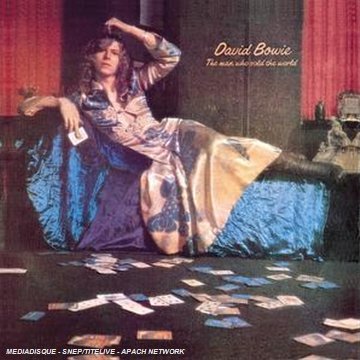
The album cover,which portays Bowie with flowing golden locks and wearing a full-length dress,is now a classic collector's item.Contrary to popular belief,the dress cover was never withdrawn from the US market because it was never actually used there in the first place.
Another interesting fact about the album is that the title was changed very late on in the day.The original title was Metrobolist.
The Man Who Sold the World also sounds so oddly formed and dark.The seeds of cyborg space-pop,later developed by the likes of the Futurists John Foxx,Gary Nauman,Bill Nelson and Thomas Dolby,are to be found on songs such as 'Saviour Machine'.The sort of childlike paranoia found on 'After All' and 'All the madmen' was a new form of Gothic melodrama,and a direct influence on Siouxsie and The Cure in the 70s and 80s,and America's Nine Inch Nails in the 90s.
Key to this bleak soundscape was Visconti and Bowie's desire to harness the newly arrived musical possibilities of the synthesizer.Visconti remembers : 'The synth was a passion of mine at the time'.


Howver,the actual recording of the album was a nightmare for the young Visconti.Accoding to Visconti,Bowie appeared distracted and undiciplined,spending more time with Angie in the lobby of the recording studio kissing,cuddling and cooing. ( 'naughty Uncle Tony says I have to do a vocal now.Bye bye Angie-wangie').Much of the music was 'arranged ' by Visconti and the band.
The album's protagonist was time and again arriving in the studio in a lyricless state,further driving the smoach-churned producer into a state of mild apoplexy.Visconti remembers : " Bowie was writing at the last minuste because (one),he wanted to,and (two) he was preocupied in the lobby of the studio with his new-found love,Angie."
The tactic of writing in the studio and coming up with lyrics for songs at the 11th hour may have fazed his friends,but Bowie was learning a new technique,which involved almost spontaneous last-minute assembly of a song's lyrical content in the studio.Bowie has never really been a concentional craftsman and,as his career progressed,he turned expediency into a tactic,developping a spontaneous creative environment.
The Man Who Sold The World worked well in artistic terms.As a commercial product,however,it was another near-fiasco,selling moderately for a while in the States,but disastrosly in the UK.Ronson went back to Hull to lvie with his parents and to work as a gardener.Moreover,shortly after the recording of the album,Visconti departed the Bowie scene to concentrate on his production work with Bolan.There was a number of reasons for Visconti quitting,but the main one was Bowie's business relationship with Defries.

____________________________________________

The Man Who Sold The World is one of my favourite albums ( you will hear this a lot from me,though!).My personal favourites are : 'All the Madmen' - I think the lyrics are phenomenal.This is one of the songs I always sing in class and annoy my classmates.The Man Who Sold The World is,lyrically,one of Bowie best works.The lyrics attracted me in the first place,and this is also one of the first Bowie songs I have heard.'Saviour Machine','She Shook Me Cold' and 'Black Country Rock' are relatively new to my "Loved Songs" section.