" We never got off on all that revolution stuff
Such a drag - too many snags "
[Mott the Hoople,"All the Young Dudes",1972,words and music by David Bowie]
And here we are!Finally we are going to speak about glam,and we have finally arrived to David's 'golden age'.
How did Bowie start the decade?Not only with his first hit single under his belt,but also with a string of commercial and artistic failures to his name,too.In 1970,he made a number of important commercial and personal decisions which would dictate the course of his career for the first half of the decade.
First,he sacked his manager,Ken Pitt;second,he 'invented' glam rock;third,he hooked up with a inexperienced rock manager but very smart businessman-lawyer named Tony Defries;and last,he decided to get angaged to his girlfriend,Angela Barnett,who for a while basket in his limelight and joined his spangled journey to stardom.
A.
The Marc Bolan - David Bowie dispute
The dispute is related to who has actually started the whole glam thing off.Marc Bolan was the first to have use glitter in his 1971
Top of the Pops show,and he claims being the godfather of glam.However,what mattered most to Bolan was stardom at any cost.Tony Visconti says: "Marc's weakness was his sense that he had 'arrived',and he never developed himself as a musician beyond the stage he was at during his hit-single years.He also got caught liying too many times - he felt he could sau anything to manipulate journalists.His tall tales were legend!David never shared any of Marc's weaknesses".Marc was less of a diplomat than Bowie,and tended to piss people off more easily.
In many respects,Bolan paved the way for Bowie.Bowie himself wrote in 1998: " The little imp opened the door".
Both had ploughed similar furrows in the late 1960s.Both were from a folk-pop base,but Bolan made the transition from minority acoustic elfin cult artist to mainstream - rogering pop god first.Bowie followed,doing it better,and taking it further,but Bolan had opened the door.

B.
The Glam Era
Calling it a glam "movement" is a bit of a misnomer as it implies a sort of united front.There were far too few American bands to actually even form a glam-rock scene over there.A scene did exist centred around the Warhol crowd in New York in 1970/71,an absrudist movement concerned not so much with music,but with theatre and film.
Very broadly speaking,there were always two wings of glam,or "glitter" rock as it was more referred to at the time:
a)
there was the arty,serious,more subversive end :
- David Bowie
- Roxy Music
- The New York Dolls
- Alice Cooper
- Lou Reed ( for a time )
b)
then,there were the lads in silly trousers
- Gary Glitter
- Sweet
- Alvin Stardust
With the exception of
Suzi Quatro( this girl is amazing,you should try some of her songs,esspecially Stumbulin' In,with Chrish Norman),glam was almost overwhelmingly male as well as overwhelmingly heterosexual.Despite all the limp-wristedness,few of the glam-rock acts were actually gay.
Elton John 'came out' in 1976,well after the high-water mark of the glam-rock movement.For the first half of the 70s,Elton was at pains to hide his homosexuality from the media and his fans.
Lou Reed,whose bisexuality was an obvious factor,stayed on the glam bandgagon for one album only.
No,UK glam rock was unremittigly male and laddish,despite the make-up and posing.
Gary Glitter was the "leader of the gang".
The Sweet,too,were all lads together,'hell raising' on a 'teenage rampage',while
Slade ( this guys are also gorgeous,try 'Far Far Away')the boozing Midlands skinheads-turned-glitter-freaks,and probably the best of glam pop bands at the time,also demonstrated their impeccably laddish credentials by misspelling their half dozen hits ( Far Far Away is an amazing song,listen to it :D ).
But you had to have real nerve to be,or indeed even to look like,
David Bowie.He soon had a community of fans who dared to be different and who ,as we shall see,were a ace apart from the rest of the glam-rock fans.
In general,Bowie was dismissive of most of the competition,although
Alice Cooper (with
School's Out for Summer),
Elton John and
Rod Stewart and
The Faces were releasing very strong material in 1972 and 1973.Bowie's competition with
Bolan was a feature of the 'glam wats' during the period.One of the few contemporary acts Bowie had any time for would appear to have been
Roxy Music.Some critics consider
Roxy Music and possibly
Steve Harley and
Cockney Rebel as the only true glam-rock bands in that they actually started their professional careers as glam or art-rock acts,rather than twiddly folkies.
The glam era was possibly the last big male-band era in UK pop:
-
Gary Glitter ( 3 nr 1s,4 nr 2s) VS Sweet ( 1 nr 1, 4 nr 2s) VS Slade (6.1,3.2) VS T-Rex ( 4.1,4.2) VS Wizzard (2.1)
This was an intensely competitive period.That's why the
Oasis VS Blur face-off in 1995,when the two Britpop acts schedueled their single relaes for the same day,was important.
So,what was glam rock all about?Was it simply,as John Lennon once put pit "just rock'n'roll with lipstick on'?
Glam rock definitely had a more show-business side,in form of the often fun Gary Glitter and the hardly ever fun Alvin Stardust.
The
Bowie version of glam was as much to do with the floutinf of gender codes and injecting a certain artiness and detachement into popular music as with attempts to shock the masses in the era of hippy,joss-stick-tingled stupefaction.Its origins are to be found in figures such as
Little Richard,whose stage persona was flamboyantly garish and androginous.
Syd Barrett,the first of the 60s psychedelic performers to wear make-up and an acknowledged influence on Bowie in particular.Before his collapse into mental illness,Barrett briefly promised an alarming future for pop,a future full of space-out tripping and flaunted convention.Barrett prefigured Bowie's space-age fascination wish songs such as 'Interstellar Overdrive','Astromine Domine','Arnold Layne'.Had Barrett continued,there might have been less room for Bowie to manoeuvre in the 1970s.But he didin't.By the earlt 1970s,he was,very sadly,a comatose wreck,pop's most famous acid casualty;an innovator destroyed before his prime.
In the hands of
Bowie,glam challenged pop's masculine ethos.Bowie's version of glam was about gender violence.Lou Reed and Iggy Pop only started to wear obtrusive make-up on stage once Bowie and Bolan had begun to do so.
Soon,every self-respecting British teen band to have at least one of its members kitted out in a fake leopard-skin jumpsuit with assorted glittery attachements.Bowie,however,had very little to do with these glitter rockers.
Hype
The origins of glam,
Bowie-style,can be traced back to the very first months of the 70s.At the Roundhouse in London,in February 1970,Bowie and his band,Hype,played one of the most significant and most indifferently received concerts in rock history.
Hype were intended as a cartoonesque caper,a sort of rock'n'roll pantomime for the new decade,and the name was intended to run counter hippy-era notions of an anti-commercialistic rock community.Bowie was Rainbow Man,wearing a cape of many colours and lots of diaphanous scarves.Drummer John Cambridge was Cowboy Man,Mick Ronson on lead guitar was Gangster Man,wearing a borrowed gold lame suit from Bowie,and bassist Tony Visconti was Hype Man,a kind of comic-book superhero.
Bowie is in no doubt that this was the first British glam-rock gig.Marc Bolan-in an attempt to get into the theatricality of the project- stood at the foot of the stage wearing a child's plastic Roman breastplate.
Tony Visconti,about the concert: "
I think that is the night that the germ of glam rock was born "
David Bowie and Mick Ronson
Ronson was a very important musical component in the Bowie sound at the time.
Visconti remembers him as charming,but adds: "
He always looked a bit lost;he hardly had an ambitious bone in his body."
Gus Dungeon also remembers Ronno with great affection:
"He was also an utterly charming fellow,I mean,just a total sweetheart and desperately embarassed at having to pull all those stunts every night during the Ziggy period.He hated doing it.He was very shy."
David Bowie and Angela
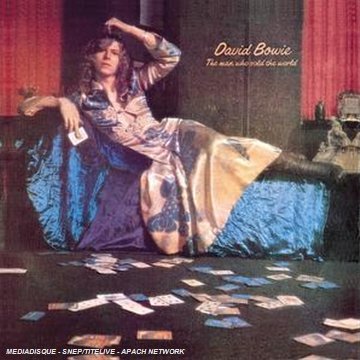
Bowie was also by now a married man.On 20 March 1970,he and Angie were wed at Beckenham Registry Office.Angie was dressed in a second hand,purple and pink,floral silk dress bought the day before.David wore tight leather trousers,black satin shirt and Afghan coat,cut something of an unconventional dash for the wedding day.Instead of rings they exchaned Peruvian bangles during the brief ceremony.The night before their wedding was spent in bed with a mutual friend.The night after was spent down the pub getting blasted.
Angela acted as a behind-the-scenes promoter of her husband's talents,persuading and pressurising record companies and pluggers,helping with the costumes,making phone calls,suggesting ideas,entertaining friends,listening to Bowie's work-in-progress.
She was also into outrage and bisexuality in a big way;her hair was often shorter,spikier and punkier than her husband's.
Many contemporaries are at pains to poit out that Bowie only really weirdified his image after living with Angie.Before the Angie years,Bowie was actually fairly quiet as an individual and had not yet discovered the flair for sartorial flamboyance we now assosicate with him.
Angiw would constantly encourage Bowie to try on new,and ever weider,designs.
Bowie and Angie always had a love\hate relationship.Manager Ken Pitt apparently strongly disliked her.Gud Dudgeon didin't get Angie either : "
I thought she was just a typical groupie.I just thought she was really loud and full of crap and I still do."
Ken Scott says about her:
"She was very flamboyant.When she walked into a room,you knew it.Musically she had no influence whatsoever.She would stop by the studio once in a while with a 'Hello,dahlings!Oh,that's lovely,yes!' and then go out and so some more shopping or something.But she was fine.I had no problems with her"
According to Angie's second biography,Bowie was quite upfront about his feelings.He told her back in 1969 that he didn't really love her,and if they married it would be something of a marriage of convenience.
'Their relationship,though,was weird;supposedly an "open relationship"' says Scott
'But every time I've heard of that,it always ends up with someone jealous,and that's what eventually happened.'
Tony Visconti says about Angie:
"She was there for him in a difficult transitional period.But I could see when this wasn't enough for her.At one concert David was surrounded by fans and Angie was next to him dressed even more outrageously than he was (her breasts were visible).Since all the attention was on him,she feigned fainting (something she did often) and suddently she created an emergency drama around herself,taking the limelight away from David."
For a while tough,everyone was a big happy family.Bowie and Angie had soon turned their home into something of a sex-and-style laboratory,picking up blokes and girls from venues such as gay disco The Sombrero,a nigh-spot frequented by Bowie mainly as a way to get a hit of the flamboyance of gay style.
Visconti remembers moving in with his wife Liz,at Bowie and Angie's place. "
Bowie was the only one among us who had any money.[...] As for wild sex - it only happened occasionally.David and Angela never tried to invove us in their sexcapades"
The Haddon Hall (their house) was apparently haunted,and Bowie spent some of the most creative years of his life there,tapping into the eerie vibe of this rambling Victorian mansion.
It was in this spooky mansion that Bowie and Angie set about starting a family of their own.By the end of the summer of 1970,Angie was pregnant.