Se afișează postările cu eticheta glam rock. Afișați toate postările

duminică, 12 februarie 2012

19.Diamond Dogs


         Diamond Dogs , recorded in late 1973 and early 1974, shows him at both most indulgent and his most creative.
         Although never really a critics' rave, the album remains one of those most admired by his hard-core following. It is the closest Bowie has ever come to the ideal of a totally theatrical pop music. Martin Kirkup commented: " Where Aladdin Sane seemed like a series of Instamatic snapshots taken from weird angles, Diamond Dogs has all the deeper colours. "
         With this album, Bowie proved that without Ken Scott,without Ronno and The Spiders, he was still able to produce work of real quality.
         Diamond Dogs was also important in that it saw him working again with then ex-chum Tony Visconti.
         During the time Visconti was concentrating on Bolan, he was watching Bowie's career unfolding : "Hunky Dory made me jealous. I had nothing to do with it, but I asked myself, Where were the songs like that when I was producing him?"
         The themes of urban decay, decadence and the apocalypse, which are the main ideas on the album, are given a psychosexual twist. He envisaged a world in which snaggle-toothed ragamuffins dressed in looted furs and diamonds took over the city. The principal character, Halloween Jack, and his gang live on top of deserted skyscrapers and travel around the city on roller-skates. Bowie says he drew inspiration for the characters of 'Hunger City' from a story told to him by his father, who worked for many years for Dr Barnado's. 

Tracks:

Side one
  1. "Future Legend" – 1:05
  2. "Diamond Dogs" – 5:56
  3. "Sweet Thing" – 3:39
  4. "Candidate" – 2:40
  5. "Sweet Thing (reprise)" – 2:31
  6. "Rebel Rebel" – 4:30
Side two
  1. "Rock 'n' Roll with Me" (lyrics: Bowie, music: Bowie, Warren Peace) – 4:00
  2. "We Are the Dead" – 4:58
  3. "1984" – 3:27
  4. "Big Brother" – 3:21
  5. "Chant of the Ever Circling Skeletal Family" – 2:00

         The album begins with the track ' Future Legend', a spoken narrative describing a future urban apocalypse. It is a portrait of a city environment on the point of collapse, and its view of a dehumanised humanity, are indicators of Burroughs' influence.


         Diamond Dogs  is a trip into grotesquerry and seedy lowlife. The title track references Tod Browning, the maker of the then banned 1932 film Freaks, one of the most controversial movies ever made,starring, as it did, men and women with real-life deformities and rare medical conditions.


         The underrated 'We Are The Dead", with its creepy electric - piano opening, funeral pace and house-of-horrors imagery, is likewise graphically Gothic.  But it's the brazen drug-referencing that is most evident: "Is it nice in your snow-storm, freezing your brain? "


         In fact "Sweet Thing/Candidate/Sweet Thing (reprise)" is the real masterpiece of the album, and it's also my favourite track from the album (in fact,I'm not sure,I love the whole album). It's in moments like this, rather than in the big hit singles or the radio-friendly songs, that Bowie's reputation as a true pop genius resides.


        For '1984' , Alan Parker plays a brilliant Shaft-inspired riff, as Bowie warns "Beware the savage jaw/Of 1984"


        The ending of the album is also quite brilliant. "Big Brother",replete with fake horns, strummed guitar and a massive wall of sound builds an  astonishingly overwrought climax which echoes some of Bowie's earlier work on The Man Who Sold The World .


        Then the song dissolves into the astonishing "Chant of the Ever-Circling Skeletal Family", a truly mesmeric and frightening chant in five/four time . It's on of the greatest moments Bowie has ever committed to tape.


        Aside from these moments of grand experimentation in sonics and theatricality, Diamond Dogs also contained two of Bowie's best ever pop songs:  " Rock'n'Roll With Me", the single that never was,pointed, ever so slightly, towards the more soulful future that would be The Young Americans period.


        And then, there's rebel rebel , which reached a surprisingly lowly Number 5 after crashing into the Top 40 once place below that in the first week of release. The last of his bona fide glam singles, it was a manifesto for all the Bowie Boys and Bowie Girls: " You got your mother in a whirl  / She;s not sure if you're a boy or a girl" sums up early -70s gender-bending perfectly. Arguably Bowie's greatest-ever riff, it was a brilliant taster for the album proper.
        Bowie performed the new single on the Dutch Show Top Pop in February,whilst in Holland for a few days to work on the new album at a studio in Hilversum. With an added eye patch ( he had gone down with a bout of conjunctivitis), the Aladdin Sane meets pirate man look was the last time we would see the full crimson spiky Bowie haircut  ( if I were to choose,I'd say this is one of Bowie's sexiest videos.I love his hair here)


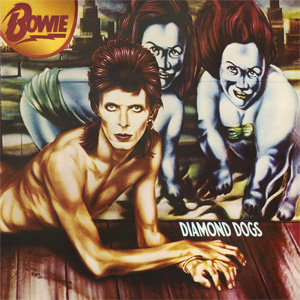
        The cover presents Bowie half-man/half-dog,and it;s one of Bowie;s most dramatic, and definitely most seedy covers ( made by the Belgian artist Guy Peellaert)
        Diamond Dogs brought the first phase of Bowie's career to an end. Released in April 1974, Diamond Dogs not only closed down Bowie's glam-rock period, but became glam-rock's epitaph.

        When he left the UK for the US in April 1974, the version of him on show was, on first inspection, a sartorially toned-down representation. The era of glitter and stack-heeled boots was indeed over,but the man himself was entering the most paranoid and out-there period of his life,a three-year period of chill, supercharged creativity. He redesigned his Ziggy cut into an epic flame-coloured parting,packed away the kabuki garb and reinvented himself as a sharply dressed soul boy in a suit. The gouster was born.


16.Killing the Kabuki Monster

             As the Ziggy tour morphed into the Aladdin Sane tour in early 1973, the shows became even more ambitious.
             By the middle of 1973, Bowie had been on the road, almost non-stop, for 18 months, in a punishing schedule that included six British tours, two American tours and a tour of Japan - more than 170 gigs in all. The Japanese tour was also a huge success. At the start of the tour, Bowie was a virtual unknown with negligible record sales ; by the end, it was mass hysteria at the concerts.
             After the Japanese gigs, there was a large gap before the next gig, at London's Earl Court. His fear of flying meant that Bowie decided to return to Europe on the Trans-Siberian express.             
             As the summer drew closer Bowie was nearing exhaustion, despite the onset of what the tabloid media had dubbed 'Bowiemania',a level of hysteria not witnessed since the Fab Four in the mid-1960s. Bowie had gone mainstream with a vengeance with profiles on BBC's Nationwide, massive exposure on radio 1, and a avid interest from the tabloids and the rock press. However, on 12 May, The Spiders played a thoroughly dispirited gig at Earl's Court. The ambience was zero, the acoustics appalling because the PA was to small for the venue, and it was impossible to see the stage itself. It was one of the first times that Earls Court had been used for a rock concert, and the stage was also too low and fans couldn't even see it properly. It was one of the few real failures of the Ziggy/Aladdin Sane era. But no one could have expected Bowie's next move.

             " Not only is it the last show of the tour, but it's the last show that we'll ever do..... Bye bye. We love you. "


             Bowie's retirement announcement from the stage of Hammersmith Odeon, immortalised in that rather grainy DA Pennebaker film, left his fans in a state of complete disbelief. Bowie, just 18 months into his fame, was bowing out for good. Little did we know that this was not the end of the story but simply the conclusion of one chapter in Bowie's career: Ziggy and glam rock era were over.
             As a historical event, the Hammersmith gig has attained a mythic dimension. It wasn't the best gig The Spiders ever played, but it was their last, and it marked the end of an era. Although concealed from The Spiders until the night of the show, Bowie's announcement was in fact carefully leaked to the press beforehand.
             After the gig, Bowie threw a huge 'retirement' do, with Mick Jagger, Lou Reed, Ringo Starr, Barbara Streisand and Lulu all in attendance. the concert was a definite turning point for Bowie. He was shedding another skin that night at Hammersmith, throwing off glam rock and paving the way for a new, bolder era of experimentation. it was a rite passage.
             But why retire at the height of your fame? the answer lies in a combination of Bowie's low boredom threshold and, more importantly, his tour weariness. Bowie was genuinely exhausted after eighteen months' gigging. Just as Ziggy bit the dust at the end of the album, so Bowie used the Hammersmith Odeon show to fuel the myth and 'retire' in actuality. Since neither he nor his audience was sure whether it was David Bowie or Ziggy Stardust up there on stage, Bowie's fans assumed Bowie's retirement was the end of his,Bowie's,career,not simply that of his alter ego.
             There were also strictly commercial reasons behind the decision to bow out. Despite the sell- out tours, The Spiders were still receiving almost the same measly wage they had been on when Ziggy was an unknown.
             Ronson had become something of a huge live draw in his own right on the Bowie tours, and had his own fan base. With Bowie exhausted and off the road, in the second half of 1973 Defries turned his attention from Batman to Robin . He genuinely liked Ronson, and was also genuine in his appreciation of the Yorkshireman;s talents. So began the process of grooming Ronson for solo super-stardom.
             Finally, and most tellingly, Bowie was tired of the sort of music he was making with The Spiders. It seems that what actually drivers Bowie more than anything is not so much premeditated attempts to colonise markets, but a real hunger for musical experimentation. On Aladdin Sane ,Bowie had already begun, with Ronson's jazzy piano, to break free from the standard pop/rock format. Songs such as 'Panis in Detorit' hinted at a more obvious R&B/soul future. Bowie was,and still is, into all sorts of music, and by the middle of 1973 it was simply time for a change.
             Aladdin Sane had seen him move away from conventional pop, and his next planned project, an adaptation of George Orwell's tale of totalitarian terror,1984, would enable him to broaden the base of his music even further. Bowie wanted to move into mode serious intellectual territory outside the band format.
             First, though, there was a record company to appease. Bowie was now at a commercial peak. In the week beginning 23 July, 5 of his 6 albums were in Top40, 3 of them in the Top 15, an unprecedented feat for a solo artist. His next record, Pin Ups , a collection of covers from the 1964 - 1967 London club scene, was something of a stopgap. Certain that the next project did not need The Spiders, he was unsure of how to break the news that not only they were out of the picture as a live backing band, but that studio projects would not concern them either.
             Bowie was becoming a little more snappy with those around him. ' The success was changing him. Bowie began believing that all the trapping of success which Defries provided, the limos and that kind of thing, has to be there. In fact, they weren't trappings any more but necessities.'

miercuri, 8 februarie 2012

13.Roxy Music and Bowie

      If Bowie was still essentially an excellent pop craftsman, then it was Roxy Music who were the avatars of change.Thematically, if not musically, there were similarities between Bowie and Roxy Music. The blast of ice nonemotion would have its disciples later in the decade (such as Gary Numan) and Marilyn Manson and Nine Inch Nail's graphic, cruel psycho-porn has its origins in the Ferry/Bowie artifice.
      Bowie and Roxy were both serious and contrived, pop and rock, jokey yet serious. Both Bowie and Ferry saw stage performance as drama and milked theatricality for all it was worth. Ferry made it an absolute prerequisite that his band looked good.
      Like Bowie, Ferry and Roxy Music delighted in the artificial.
      Bryan Ferry recalls: "Our music was not so much designed for the charts as for thinking audience. We didn't see ourselves as part of a glam-rock movement at all ... We were conscious of Marc Bolan and Bowie but we thought we were very much doing our own thing. "
      Roxy Music and Eno were actually the other side of the same coin. Bowie took from high art (such as steal from Baudelaire, or a namecheck for Jean Genet) and used it in pop ; Ferry and Eno took from un-artistic popular culture and turned it into art-pop. Whatever the spin, it made it for a thrilling musical experience.
      many critics were initially highly sceptical of them and they criticised them for almost exactly the same reasons they did Bowie. However, Roxy Music had the last laugh, of course, and eventually found themselves at Number 1 in the UK album charts late in 1973 with their third album, Stranded.


      Roxy were the only serious rivals to Bowie in the period 1972 to 1975. Although the media hype was centred on Bowie's rivalry with Bolan, in actuality it was Roxy Music who were Bowie's direct competitors. A huge number of Roxy Music fans were Bowie fans too. It's no surprise that in 1975 and 1976, when punk was breaking, many of the leading lights would declare for Bowie and Ferry, while trashing Rod and Elton.
      Bowie and Roxy kept a deliberate, watchful distance in the glam-rock era. Roxy Music played with Bowie at the Croydon Greyhound in June 1972. "He was on a roll at the time and we were just emerging. I think he asked for us to join him on tour. It was a very good audience for both turns", says Ferry.
      If with Roxy's first record we can see the beginnings of a definite rupture with the past,then conceptually,Ziggy Stardust is more important. The writer Jon savage called "Ziggy Stardust" the first post-modern pop record.


sâmbătă, 28 ianuarie 2012

11.Ziggy Stardust

" I'm going out to bloody entertain, not just get up on a stage and knock off a few songs. I couldn't do that. I'm the last person to pretend that I'm a radio. I'd rather go out and be a colour television set. "
                                                                                            (Bowie in 1972)

    He had his own album. He had his own, very particular, hairdo, which was copied by both men and women. He brought cross- dressing, glitter and make-up to the high street. He's the most famous fictional rock star ever. He has a website devoted to him. He's had whole books written about his. Numerous tribute bands have sprung up in his wake, His last ever performance was turned into a film, a documentary about a complete fiction. There was even a Ziggy Stardust hotel in Thailand. His creator, David Bowie, ne Jones, has been inundated with offers to resurrect him in a musical. Quite simply, Ziggy made David Bowie a star. And Ziggy Stardust will go down in history as Bowie's finest creation.
    Bowie first mentioned his character Ziggy on a tour in America in 1971. 
    Ziggy was a composite rocker, and was based on two cult pop artists in particular.
  • One was the Legendary Stardust Cowboy - a sort of thrash country- and-western star
  • Vince Taylor (Bowie remembers: " He was out of his gourd. He was unfolding a map of the metropolis on the pavement, and he would just start pointing out sites where UFOs were going to land." ). Taylor was a cult figure possessed with a mad genius, his story was a rock'n'roll tragedy and a perfect example of rock martyrdom. (he died at the age of 52, in 1991 )
     Another immediate influence on the Ziggy creation was Stanley Kubrick's film version of the Anthony Burgess novel, A Clockwork Orange. 
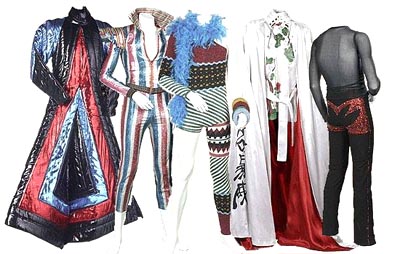
     But perhaps the biggest influence of all came not from rock music at all, but from Japanese culture. First, Bowie has said that Japanese designer Kansai Yamamoto was "one hundred per cent responsible for the Ziggy haircut and colour ". Second, Japan's influence of Ziggy came from its peculiarly stylised theatre. Bowie was fascinated by Japanese kabuki and No theatre and appropriated their essence for the Aladdin Sane shows.
     In fact, there appear to be two quite distinct eras, The 1972 tours in support of Ziggy were rocky, punky and brash; not without theatricality, but still very much part of the accepted way of framing a rock gig. However, once Bowie started promoting Aladdin Sane in 1973, the costuming becomes far more elaborate and garish. And Bowie's fascination with all things Japanese was crucial in defining the Aladdin Sane era.
     In the West, Japan was traditionally viewed as an 'alien' culture. Bowie's Ziggy dignified Japanese culture and showed him open to ideas outside Anglo-American rock. Bowie helped internationalise pop, starring a long-running fascination with the East. He later became one of Japan's biggest idols.
     The use of kabuki styles in rock performance was an innovation.Some of the costumes for the Ziggy Stardust and Aladdin Sane shows were actually first used in kabuki theatre, others were designed for Bowie by Kansai Yamamoto , again based on traditional designs.
 The overall visual effect of these shows was that of a blurring of 'found' symbols from science fiction - a space age high heels, glitter suits and the like - with kabuki-style garments whose effect was to signify the codes of another culture, one alien to Western society. Kabuki was perfect for the Aladdin Sane shows in that,by its very nature, it is a 'gender-bending' theatrical form.In Kabuki theatre,all parts,both men and women,are played by men. Its androgynous nature was elevated by Bowie to a position of fundamental importance.
     The constant changing of costume, so evident in both Ziggy and Aladdin Sane stage shows, also had its origins in kabuki. A change of kimono meant a change of personality.


sâmbătă, 24 decembrie 2011

8.The Man Who Sold the World

The follow-up singles to 'Space oditty' were all commercial failures - 'The Prettiest Star','Memory of a Free Festival' and 'Holy Holy'.
Bowie's musical influences continued to be bizarrely eclectic,as Tony Visconti remembers :"It's no secret that he was always into The Velvet Underground.He also liked Van Morrison...He also liked that writer of 'Buzz The Fuzz'(Biff Rose),Jacque Brel ( the Mort Shuman English versions aswell),Ken Nordine,Marc Bolan'
Howver,the sound Bowie was developing both live and in the studio was becoming heavier,more focused and theatrical.The Man Who Sold The World ( released in Nov 1970 in the US and April 1971 in the UK),was decidedly more bleak and forbidding than the progressive chic of Space Oddity era.It's his most autobiographical work to date,it was also of real quality,a haunted piece of Gothic rock'n'roll,all sinister sgadings and bleak presents.
In an interview in 1993,Bowie spoke openly for the first time about the fear of insanity which hung over him in the 1970s and influenced a large proportion of his work : " There were far too many suicides for my liking - and that was something I was terribly fearful of. [...] As long as I could put those psychological excesses into my music and into my work I could always be throwing it off".

Content:
The Width Of A Circle
All The Madmen
Black Country Rock
After All
Running Gun Blues
Saviour Machine
She Shook Me Cold
The Man Who Sold The World
The Supermen


Against this background,the album's signature song has to be 'All the Madmen',which directly references his stepbrother Terry's plight ( he lived in the local asylum until his suicide in 1985).It empathises with him and contrasts the derangement of the internees with the corrupt values of a society which institutionalises madness.Lyrically,this is one of Bowie's most disturbing songs.Musically,the descant recorder gives the song a childlike dementia,like a seven-year-old's first music lesson turned evil.


'All the Madmen',like 'The Supermen',shows that the young Bowie was hip to Nietsche.Nietsche makes his madman rant and drool in the market square in a parody of the ravings of a demented preacher.
'After all' is the hidden gem on the album,a gorgeous melody with a somtach-churning merry-go-round synthesised section is the middle eight in waltz time.'After all ' is the first of Bowie's mini-manifestations for his chosen children,depicting himself and his flock 'painting our faces and dressing in thoughts from the skies'.With the line in the final verse,'Live till your rebirth and do what you will',Bowie is echoing the occultist teachings of the 18th and 19th century diabolist Aleister Crowley,whose maxim was 'Do what thou wilt'.Bowie seems to be envisaging a fan base of star-child occultists.


The much-lauded title track is lyrically Bowie's boldest statement yet of his sense of psychic unease.'The Man Who Sold The World' has a lilting melody,an almost bossa-nova-style rythm section.It was also covered in 1993 by Nirvana for their Unplugged session for MTV. 'I thought you'd died alone,a long,long time ago'.
'The Width Of A Circle' shows Bowie at his most daring.It containts Mick Ronson's most explosive moments on a Bowie album,as his lead guitar Kafkaesque transmogrification : 'Then I ran across a monster who was sleeping by a tree/And I looked and frowned and the monster was me'.
The closing track,'The Supermen',is just as sinister.The song is all towering spirals of sound.
The Man Who Sold The World depicts a world of almost satanic,neo-occultist perversion('The Width of a Circle'),a future hell in which the interface between man and machine has corrupted the species ('Saviour Machine'),where lust and dsire replace the sort of cosy,cliched,heterosexualised monogamy peddled by the pure pop tunesmiths of the 60s ('She shook me cold'.Bowie is haunted by the real possibility of his own personality shattering into so many constituent parts ('The Width...','All the Madmen','The Man Who...').
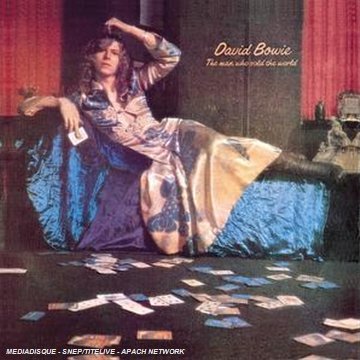
The album cover,which portays Bowie with flowing golden locks and wearing a full-length dress,is now a classic collector's item.Contrary to popular belief,the dress cover was never withdrawn from the US market because it was never actually used there in the first place.
Another interesting fact about the album is that the title was changed very late on in the day.The original title was Metrobolist.
The Man Who Sold the World also sounds so oddly formed and dark.The seeds of cyborg space-pop,later developed by the likes of the Futurists John Foxx,Gary Nauman,Bill Nelson and Thomas Dolby,are to be found on songs such as 'Saviour Machine'.The sort of childlike paranoia found on 'After All' and 'All the madmen' was a new form of Gothic melodrama,and a direct influence on Siouxsie and The Cure in the 70s and 80s,and America's Nine Inch Nails in the 90s.
Key to this bleak soundscape was Visconti and Bowie's desire to harness the newly arrived musical possibilities of the synthesizer.Visconti remembers : 'The synth was a passion of mine at the time'.


Howver,the actual recording of the album was a nightmare for the young Visconti.Accoding to Visconti,Bowie appeared distracted and undiciplined,spending more time with Angie in the lobby of the recording studio kissing,cuddling and cooing. ( 'naughty Uncle Tony says I have to do a vocal now.Bye bye Angie-wangie').Much of the music was 'arranged ' by Visconti and the band.
The album's protagonist was time and again arriving in the studio in a lyricless state,further driving the smoach-churned producer into a state of mild apoplexy.Visconti remembers : " Bowie was writing at the last minuste because (one),he wanted to,and (two) he was preocupied in the lobby of the studio with his new-found love,Angie."
The tactic of writing in the studio and coming up with lyrics for songs at the 11th hour may have fazed his friends,but Bowie was learning a new technique,which involved almost spontaneous last-minute assembly of a song's lyrical content in the studio.Bowie has never really been a concentional craftsman and,as his career progressed,he turned expediency into a tactic,developping a spontaneous creative environment.
The Man Who Sold The World worked well in artistic terms.As a commercial product,however,it was another near-fiasco,selling moderately for a while in the States,but disastrosly in the UK.Ronson went back to Hull to lvie with his parents and to work as a gardener.Moreover,shortly after the recording of the album,Visconti departed the Bowie scene to concentrate on his production work with Bolan.There was a number of reasons for Visconti quitting,but the main one was Bowie's business relationship with Defries.

____________________________________________

The Man Who Sold The World is one of my favourite albums ( you will hear this a lot from me,though!).My personal favourites are : 'All the Madmen' - I think the lyrics are phenomenal.This is one of the songs I always sing in class and annoy my classmates.The Man Who Sold The World is,lyrically,one of Bowie best works.The lyrics attracted me in the first place,and this is also one of the first Bowie songs I have heard.'Saviour Machine','She Shook Me Cold' and 'Black Country Rock' are relatively new to my "Loved Songs" section.

marți, 20 decembrie 2011

7.Look out all you rock'n'rollers,1970-1972

" We never got off on all that revolution stuff
Such a drag - too many snags "

[Mott the Hoople,"All the Young Dudes",1972,words and music by David Bowie]

And here we are!Finally we are going to speak about glam,and we have finally arrived to David's 'golden age'.

How did Bowie start the decade?Not only with his first hit single under his belt,but also with a string of commercial and artistic failures to his name,too.In 1970,he made a number of important commercial and personal decisions which would dictate the course of his career for the first half of the decade.
First,he sacked his manager,Ken Pitt;second,he 'invented' glam rock;third,he hooked up with a inexperienced rock manager but very smart businessman-lawyer named Tony Defries;and last,he decided to get angaged to his girlfriend,Angela Barnett,who for a while basket in his limelight and joined his spangled journey to stardom.

A. The Marc Bolan - David Bowie dispute

The dispute is related to who has actually started the whole glam thing off.Marc Bolan was the first to have use glitter in his 1971 Top of the Pops show,and he claims being the godfather of glam.However,what mattered most to Bolan was stardom at any cost.Tony Visconti says: "Marc's weakness was his sense that he had 'arrived',and he never developed himself as a musician beyond the stage he was at during his hit-single years.He also got caught liying too many times - he felt he could sau anything to manipulate journalists.His tall tales were legend!David never shared any of Marc's weaknesses".Marc was less of a diplomat than Bowie,and tended to piss people off more easily.
In many respects,Bolan paved the way for Bowie.Bowie himself wrote in 1998: " The little imp opened the door".
Both had ploughed similar furrows in the late 1960s.Both were from a folk-pop base,but Bolan made the transition from minority acoustic elfin cult artist to mainstream - rogering pop god first.Bowie followed,doing it better,and taking it further,but Bolan had opened the door.


B. The Glam Era

Calling it a glam "movement" is a bit of a misnomer as it implies a sort of united front.There were far too few American bands to actually even form a glam-rock scene over there.A scene did exist centred around the Warhol crowd in New York in 1970/71,an absrudist movement concerned not so much with music,but with theatre and film.
Very broadly speaking,there were always two wings of glam,or "glitter" rock as it was more referred to at the time:

a)there was the arty,serious,more subversive end :
- David Bowie
- Roxy Music
- The New York Dolls
- Alice Cooper
- Lou Reed ( for a time )

b)then,there were the lads in silly trousers
- Gary Glitter
- Sweet
- Alvin Stardust


With the exception of Suzi Quatro( this girl is amazing,you should try some of her songs,esspecially Stumbulin' In,with Chrish Norman),glam was almost overwhelmingly male as well as overwhelmingly heterosexual.Despite all the limp-wristedness,few of the glam-rock acts were actually gay.Elton John 'came out' in 1976,well after the high-water mark of the glam-rock movement.For the first half of the 70s,Elton was at pains to hide his homosexuality from the media and his fans.Lou Reed,whose bisexuality was an obvious factor,stayed on the glam bandgagon for one album only.
No,UK glam rock was unremittigly male and laddish,despite the make-up and posing.Gary Glitter was the "leader of the gang".The Sweet,too,were all lads together,'hell raising' on a 'teenage rampage',while Slade ( this guys are also gorgeous,try 'Far Far Away')the boozing Midlands skinheads-turned-glitter-freaks,and probably the best of glam pop bands at the time,also demonstrated their impeccably laddish credentials by misspelling their half dozen hits ( Far Far Away is an amazing song,listen to it :D ).
But you had to have real nerve to be,or indeed even to look like,David Bowie.He soon had a community of fans who dared to be different and who ,as we shall see,were a ace apart from the rest of the glam-rock fans.
In general,Bowie was dismissive of most of the competition,although Alice Cooper (with School's Out for Summer),Elton John and Rod Stewart and The Faces were releasing very strong material in 1972 and 1973.Bowie's competition with Bolan was a feature of the 'glam wats' during the period.One of the few contemporary acts Bowie had any time for would appear to have been Roxy Music.Some critics consider Roxy Music and possibly Steve Harley and Cockney Rebel as the only true glam-rock bands in that they actually started their professional careers as glam or art-rock acts,rather than twiddly folkies.
The glam era was possibly the last big male-band era in UK pop:

- Gary Glitter ( 3 nr 1s,4 nr 2s) VS Sweet ( 1 nr 1, 4 nr 2s) VS Slade (6.1,3.2) VS T-Rex ( 4.1,4.2) VS Wizzard (2.1)

This was an intensely competitive period.That's why the Oasis VS Blur face-off in 1995,when the two Britpop acts schedueled their single relaes for the same day,was important.


So,what was glam rock all about?Was it simply,as John Lennon once put pit "just rock'n'roll with lipstick on'?
Glam rock definitely had a more show-business side,in form of the often fun Gary Glitter and the hardly ever fun Alvin Stardust.
The Bowie version of glam was as much to do with the floutinf of gender codes and injecting a certain artiness and detachement into popular music as with attempts to shock the masses in the era of hippy,joss-stick-tingled stupefaction.Its origins are to be found in figures such as Little Richard,whose stage persona was flamboyantly garish and androginous.
Syd Barrett,the first of the 60s psychedelic performers to wear make-up and an acknowledged influence on Bowie in particular.Before his collapse into mental illness,Barrett briefly promised an alarming future for pop,a future full of space-out tripping and flaunted convention.Barrett prefigured Bowie's space-age fascination wish songs such as 'Interstellar Overdrive','Astromine Domine','Arnold Layne'.Had Barrett continued,there might have been less room for Bowie to manoeuvre in the 1970s.But he didin't.By the earlt 1970s,he was,very sadly,a comatose wreck,pop's most famous acid casualty;an innovator destroyed before his prime.
In the hands of Bowie,glam challenged pop's masculine ethos.Bowie's version of glam was about gender violence.Lou Reed and Iggy Pop only started to wear obtrusive make-up on stage once Bowie and Bolan had begun to do so.
Soon,every self-respecting British teen band to have at least one of its members kitted out in a fake leopard-skin jumpsuit with assorted glittery attachements.Bowie,however,had very little to do with these glitter rockers.

Hype

The origins of glam,Bowie-style,can be traced back to the very first months of the 70s.At the Roundhouse in London,in February 1970,Bowie and his band,Hype,played one of the most significant and most indifferently received concerts in rock history.
Hype were intended as a cartoonesque caper,a sort of rock'n'roll pantomime for the new decade,and the name was intended to run counter hippy-era notions of an anti-commercialistic rock community.Bowie was Rainbow Man,wearing a cape of many colours and lots of diaphanous scarves.Drummer John Cambridge was Cowboy Man,Mick Ronson on lead guitar was Gangster Man,wearing a borrowed gold lame suit from Bowie,and bassist Tony Visconti was Hype Man,a kind of comic-book superhero.
Bowie is in no doubt that this was the first British glam-rock gig.Marc Bolan-in an attempt to get into the theatricality of the project- stood at the foot of the stage wearing a child's plastic Roman breastplate.
Tony Visconti,about the concert: " I think that is the night that the germ of glam rock was born "


David Bowie and Mick Ronson


Ronson was a very important musical component in the Bowie sound at the time.
Visconti remembers him as charming,but adds: "He always looked a bit lost;he hardly had an ambitious bone in his body."
Gus Dungeon also remembers Ronno with great affection: "He was also an utterly charming fellow,I mean,just a total sweetheart and desperately embarassed at having to pull all those stunts every night during the Ziggy period.He hated doing it.He was very shy."


David Bowie and Angela

Bowie was also by now a married man.On 20 March 1970,he and Angie were wed at Beckenham Registry Office.Angie was dressed in a second hand,purple and pink,floral silk dress bought the day before.David wore tight leather trousers,black satin shirt and Afghan coat,cut something of an unconventional dash for the wedding day.Instead of rings they exchaned Peruvian bangles during the brief ceremony.The night before their wedding was spent in bed with a mutual friend.The night after was spent down the pub getting blasted.

 Angela acted as a behind-the-scenes promoter of her husband's talents,persuading and pressurising record companies and pluggers,helping with the costumes,making phone calls,suggesting ideas,entertaining friends,listening to Bowie's work-in-progress.
 She was also into outrage and bisexuality in a big way;her hair was often shorter,spikier and punkier than her husband's.
 Many contemporaries are at pains to poit out that Bowie only really weirdified his image after living with Angie.Before the Angie years,Bowie was actually fairly quiet as an individual and had not yet discovered the flair for sartorial flamboyance we now assosicate with him.
 Angiw would constantly encourage Bowie to try on new,and ever weider,designs.


 Bowie and Angie always had a love\hate relationship.Manager Ken Pitt apparently strongly disliked her.Gud Dudgeon didin't get Angie either : " I thought she was just a typical groupie.I just thought she was really loud and full of crap and I still do."
Ken Scott says about her: "She was very flamboyant.When she walked into a room,you knew it.Musically she had no influence whatsoever.She would stop by the studio once in a while with a 'Hello,dahlings!Oh,that's lovely,yes!' and then go out and so some more shopping or something.But she was fine.I had no problems with her"

According to Angie's second biography,Bowie was quite upfront about his feelings.He told her back in 1969 that he didn't really love her,and if they married it would be something of a marriage of convenience.'Their relationship,though,was weird;supposedly an "open relationship"' says Scott 'But every time I've heard of that,it always ends up with someone jealous,and that's what eventually happened.'

Tony Visconti says about Angie: "She was there for him in a difficult transitional period.But I could see when this wasn't enough for her.At one concert David was surrounded by fans and Angie was next to him dressed even more outrageously than he was (her breasts were visible).Since all the attention was on him,she feigned fainting (something she did often) and suddently she created an emergency drama around herself,taking the limelight away from David."

For a while tough,everyone was a big happy family.Bowie and Angie had soon turned their home into something of a sex-and-style laboratory,picking up blokes and girls from venues such as gay disco The Sombrero,a nigh-spot frequented by Bowie mainly as a way to get a hit of the flamboyance of gay style.
Visconti remembers moving in with his wife Liz,at Bowie and Angie's place. " Bowie was the only one among us who had any money.[...] As for wild sex - it only happened occasionally.David and Angela never tried to invove us in their sexcapades"

The Haddon Hall (their house) was apparently haunted,and Bowie spent some of the most creative years of his life there,tapping into the eerie vibe of this rambling Victorian mansion.
It was in this spooky mansion that Bowie and Angie set about starting a family of their own.By the end of the summer of 1970,Angie was pregnant.
1.Uncage the colours

"Bowie was never meant to be.He's like a Lego kit.I'm convinced I wouldn't like him,because he's too vacuous and undisciplined.There is no definitive David Bowie"
( David Bowie on David Bowie,1976)

This is how the books starts.It seems that the real David Robert Jones is very different from his artistic ego,thing that I'm about to find out in this book.
David Bowie is one of the most photographed,adored,imitated,admired and talked-about rock star of the post-Beatles period.He is the one that invented character-playing in pop,marrying theatre and popular music in one seamless,powerful whole.He virtually defined the ways in which pop and video could be combined,with a series of stunningle inventive videos.
In the UK he was perhaps the most written-about pop star of his age.He was serios and trashy,manipulative and manipulated,and ( for a time at least) both man and woman.

Bowie had a great hold on young people's lives in the UK arguably for longer than any other pop star living or dead,longer even than The Beatless.Between 1972 and 1983,Bowie wasn't simply liked or admired - in the UK at least,he was almost worshipped.For every teenager who considered him or herself unfinished,who was not quite happy with his or her lot,who didn't like the way the society worked but couldn't articulate that sense of disquiet,Bowie was the perfect foil.It's no wonder that so many punks were originally Bowie fans.For those unsure about their sexuality or who were in agonies about "coming out",Bowie at least let them know that someone was listening : " You got your mother in a whirl\She's not sure if you're a boy or a girl" - 'Rebel Rebel',1974 .
Through such simple words,Bowie changed people's lives.For all those who felt lost,disenfranchised,alone or sad,Bowie acted out pop therapy: " Your not alone..Give me your hands,'Cos you're wonderful: - 'Rock'n'Roll Suicide,1972.

Singers and bands influenced by David Bowie:
  • had a powerful impact on punk : Siouxsie Sioux,Billy Idol were David Bowie fans. Johnny Rotten,who hated David Bowie,borrowed his haircut,while Sid Vicious was a Bowie casualty first,rock casualty second
  • Bunnyman Ian McCulloch
  • Holly Johnson
  • Boy George
  • Morrisey
  • Kate Bush (who borrowed his mime tutor,Linsday Kemp)
  • Gary Numan ( who borrowed Bowie's light show,sang froid and sneer)
  • the whole new romantic scene,the slicked back soulsters of the New Pop era ( ABC,Associates,Spandau Ballet)
  • the synth-pop duos ( Soft Cell,Pet Shop Boys,The Eurythmics)
  • in America,the 3 biggest pop icons of the 1980 : Madonna,Prince and Michael Jackson were hugely indebted to Bowie's sly shape-chnaging (Madonna dates her conversion to actually wanting to be a star to a Ziggy concert she attended at the age of fifteen)
  • in the 90s,UK groups as Suede (a neat rearticulation of Ziggy-era kitchen-sink gender-bending)
  • American bands such as Nine Inch Nails,Nirvana,The Smashing Pumpkins and Marylin Manson
  • Oasis ( in 1997,Oasis enjoyed a UK Top 3 hit - Stand by me - with a chours which echoes Bowie's ' All the Young Dudes '
  • Blur (Bowie parody/homepage,M.O.R.)
  • Supergrass ('Pumping On Your Stereo' - is a slice of 'Rebel Rebel' dosed riff rock)
  • U2
In the Noughties,it's now cool to say you love David Bowie,and everyone and his dog claims to be at least partly desended from the original Diamond Dog.

That Bowie had such an effect on fellow musicians is hardly surprising.His recordings amount to a stunning body of work: rich,exciting,fun,mysterious and deeply moving,encompassing pop,ambient,rock,soul,jazz,folk,techno,jungle ( in 1997 he even performed a country-and-western version of ' Scary Monsters ' in the States).Bowie offered the paradigmatic proof that fleet-footed changes of image and music,packaged well and presented impeccably,were the perfect receipe for career longevity.Smart,shrewd,sexy and immensely talented,Bowie prooved that to stay ahead,to stay vital,it was necessary to change.
Bowie wasn't quite original to be a true academic or intellectual (like Eno),he wasn't somehow authentic enough to be an all-out rocker (like Jagger)and he was too masculine to be an all-out drag queen ( like Wayne County).He was ,and remains,the perfect liminal pop star,an utterly convincing media re-enactment of our times,deep and serious yet frivolous and lightweight.

Though,the middle-aged dad,the everyday sleeping,eating,breathing,living David Robert Jones,is known by very,very few.David Bowie himself is largely a media monster,the greatest rock persona ever created,and only tangentially part of the personality of David Jones himself.Bowie has made camouflage and misinformation part of his actual art.


*I'd like to mention that this is my first post written in English.I hope I did it well.