Se afișează postările cu eticheta Angela. Afișați toate postările

duminică, 12 februarie 2012

14.The American Tour

I looked at the way Bowie presented himself in that whole 72-73 period and I just thought ,and  i still do to this day, that it was the greatest rock'n'roll star image that there has ever been
 Gary Numan 1998          

            In the autumn of 1972, Bowie set sail for the States. Already the biggest pop star to have emerged in the UK during 1972, it was vital that the holy grail of American success came Bowie's way. The Bowie contingent were on a high, full of hope, and sure that American success was just around the corner.
            One aspect of British pop that had completely failed to grab the Americans' attention was its androgyny. Whereas Britain has had an arty wing of lipstick-glossed rockers since the 1970s, America has, despite the early intervention of Little Richard, been very late in developing the tradition (with the Smashing Pumpkins, Nirvana, Nine Inch Nails or Suede)
            It's usually only a certain type of act that can clean up the dollars. In the 1970s, Elton John's high musical values in the studio and showmanship on stage made him the biggest-selling British artist there, with Rod Stewart not far behind. The largely anonymous Mick Jones sang his way to multi-dollar success,as did Fleetwood Mac,who were at least half-British. But the likes of art rockers Roxy Music went largely unloved. Bolan had had some limited success, but he was hardly a big star. Intensely competitive and driven, Bowie was determined to go one better.
            Back to the tour, Angie was an unwanted distraction on tour - after causing a disturbance in a hotel pool with one of her affairs late at night during a tour of the Southern States she was packed off home. From that moment on, Angie was never an integral part of Bowie's touring regimen. The cracks in the Bowie marriage were already beginning to show. Both were massively promiscuous, and when both started to parade their affairs in front of each other's noses (and then to make love to each other's friends), jealousy started to rot their 'open' relationship. Angie, convinced that Bowie and MainMan would make her a star, became increasingly disillusionated when the focus resolutely remained on her husband. 
            Despite generating a fortune for his record company and manager, the artist himself lived on advances, handouts and credit in rented accommodation in the UK, and hotels and apartments abroad. He lived in the myth of being David Bowie, driven, almost maniacally, from album to tour to album by a cold, indomitable will.
            Bowie's friends and workmates noticed him becoming more distant, and perhaps less friendly. Reminiscing in 2004, Bowie remembers feeling "displaced" : "There was a time when what I was doing...didn't seem to resemble anybody else was doing. I didn't understand what I was doing, but it just seemed out of touch with what everyone else was doing."
            Travis Bolder recalls: " We only saw him as we walked on stage. He separated himself from us towards the end, he was like a solo artist that didn't need us. The bigger he got, the bigger his head got, and the less important you were to him".
            Bowie signed an employment agreement with MainMan management and production company in September 1972 that assigned to Defries a 'timeless' term of office as Bowie's manager. Under the terms of agreement, Bowie was given a guaranteed allowance of 300 £ . In return, he'd signed his life away. Mainman had exclusive rights to Bowie's person and could also 'fictionalise' the singer's biography for press purposes. In effect, Mainman could tell a pack of lies about Bowie and he would have no comeback.
            By late 1973, as Ken Scott recollects, Defries' influence over Bowie was all-encompassing: " It was difficult to tell how much was David and how much was Defries"
            The MainMan days were possibly the most controversial of Bowie's career, involving as they did a hugely extravagant 'shagathon', with Bowie largely broke, and his wife Angie running up colossal debts in shoe shops and boutiques while desperately trying to cut as an actress ( she was later notably turned down for the lead in Wonder Woman)


            Friend and photographer Mick Rock puts it like this:
"It was part of the theatre to treat him like a star. Defries could then start talking about David having an exclusive photographer.  People were saying, 'David Bowie's got an exclusive photographer.Who the fuck is David Bowie?' The people reasoned: 'If he's got an exclusive photographer and bodyguards, there must be something going on. ' That was a piece of living theatre, if you like, part of the whole thing that Tony and David cooked up between them".


            Ken Scott remembers:
 " Defries made a fortune for himself! Bowie was completely stiffed by Defries and when something like that happens, you just pass it on, it's a fact of life.... Bowie got completely stiffed by Defries and he passed it on to others. Bowie had to become tight to survive and he just kept it going because he certainly wasn't tight to start with. Bowie was broke! He was putting on these incredibly extravant tours and he was paying for them completely out of his 50 per cent. it was completely unheard of! "


            The personality of Bowie's band was changing rapidly. The whole Bowie entourage was becoming considerably more weird than Bowie himself - he has just hired a new pianist, Mike Garson ,which was a scientologist.
            This general unrest among the ranks came at a time when Bowie was called upon to deliver new product, the first album to be written from a position of fame. In many cases such albums are either a frightened excursion in water-treading,with the artist cowed into giving the punters more of what they know ( the boring option and one preferred by artist too numerous to mention) , or a confused melody of paranoia and unhappiness in an interesting gee-it's-hell-at-the-top-having-all-this-money sort of way. For this new album, Bowie chose the second option, but fashioned the paranoia of the superstar into a fantastically innovative record.

marți, 27 decembrie 2011

9.Hunky Dory

Tony Defries and David Bowie


   Tony Defries may have put Visconti off,but without him it's arguable wheter Bowie would have ever attained superstar status.Once Defries realised what he had,he channelled all his energies into making Bowie big.
   Visconti remembers about his decision to leave Bowie: " I decided to concentrate on Marc's blossoming career instead.It seemed more stable and more positive.I can't remember what we said to each other,but David had a very hurt expression on his face and I just turned and left quickly.I didn't feel all that great,but I couldn't stand Defries and I couldn't get it across to David that Defries awas not all that he seemed."
   With Defries,a new phase in Bowie's career was about to begin.


Zowie Bowie

    1971 was an enormously disciplined and prolific year,productive in more ways than one.On 30 May 1971,Bowie's son,named Duncan Zowie Haywood Jones was born in Bromley Hospital.


     It was a painful birth for Angie,who cracked her pelvis during the thirty0hour labour.Bowie himself was at home when the news of the arrival of his son was relayed to him,listening to a Neil Young record.Trading on the vibe of wistful folkiness,Bowie wrote "Kooks" ,a pastiche of early-70s Neil Young and a present for his new son.
     For their part,the arrival of little Zowie had little discernible impact either on David and Angie as a couple,or on Bowie's muse.Bowie had always liked children.His friends and work associates often comment that he;s good with their sons and daughters and finds time to play with them.Therefore,Angie and David were part-time mum and dad.It was onlt in the late 70s that Bowie realised he was missing out,and that his son needed his dad around.


   Profesionally,things really kicked into gear during 1971.
   Bowie began this period more as a songwriter than performer.He also spent a week in the hospital after he got the starting handle of the car impaled in his thigh narrowly missing a main artery.He also had many separate projects during 70-71s,mainly as a songwriter for other bands.


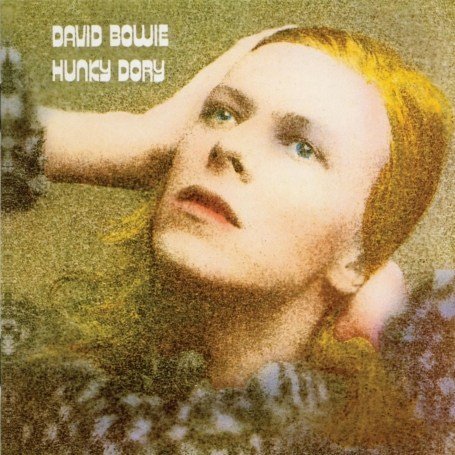
Hunky Dory


   Hunky Dorry is many people's favourite David Bowie album.It is one of my favourite albums aswell,and I think this the album I have listened to the most.I was absolutely in love with this album,and for a long period,this was my favourite.You can check my last.fm account :D.
   The work for the album started in late May 1971,and completed in August.
   Ken Scott says about the album: " On The Man Who Sold The World" he was still more of a trend-follower than a trend setter and it wasn't until Hunky Dory  ,when it was "To hell with everyone.I'm gonna do what I want to do",that he began to hit his stride.'
   Along with its successor Ziggy Stardust and Let's Dance from the 80s  Hunky Dory  is the album most likely to be found in the non-Bowie fan record collection.

Content:

Side one
  1. "Changes" – 3:37
  2. "Oh! You Pretty Things" – 3:12
  3. "Eight Line Poem" – 2:55
  4. "Life on Mars?" – 3:53
  5. "Kooks" – 2:53
  6. "Quicksand" – 5:08
Side two
  1. "Fill Your Heart" (Biff Rose, Paul Williams) – 3:07
  2. "Andy Warhol" – 3:56
  3. "Song for Bob Dylan" – 4:12
  4. "Queen Bitch" – 3:18
  5. "The Bewlay Brothers" – 5:22

   Side two has 3 tribute songs : to Warhol (Andy Warhol),(Dylan Song for Bob Dylan ) and The Velvet Underground and Lou Reed ( Queen Bitch ).With these three ,bowie redefined the notion of pop star as fan,and  elided the boundaries between the two.Of the three homages,Queen Bitch  works the best.It's probably Bowie's poppiest song from the earlt 70s never to be released as the A-side of a single,and is made all the more interesting by Bowie's curious and quite wonderful,vocal accenting.
   For The Bewlay Brothers ,Bowie looked inawrd.Thematically,the song updates and improves The Man Who Sold The World 's central concern of familial dysfunction.A series of weird-angle snapshots concentrate firmly on the concept of identity,its mutability,and its eventual disintegration: "I was Stone and he was Wax / So he could scream,and still relax,unbelievable" . The Bewlay Brothers  remains one of Bowie;s most disquieting moments on tape,and encapsulation of some distant,indefinable quality of expressionistic terror.


   Oh You Pretty Things  is a sort of 70s update of McCartney's Martha My Dear .Seeing ' cracks in the sky',certainly qualifies the young Bowie for a course of psychoanalysis,and the 'homo superior' and 'the golden ones' are direct references to the teachings of occultist Aleister Crowley.


   Another perennial favourite is the twee Kooks ,written for the newly born Zowie


  Quicksand  is almost Buddhist in its spiritualism - "Knowledge comes with death;s release "


Song for Bob Dylan  is probably the weakest song on the album,but its lyric analyses the lack of a hero figure in rock.Bowie had been much enamoured with Dylan.


    One song,the opening track,Changes ,was Bowie's edict for the 1970s.Bowie sings: " So I turned myself to face me / But I've never caught a glimpe / Of how the others must see the faker / I'm much too fast to take the test".The lyric emphasises the themes of identity,the mutability of character,and a sense of play with first and third person,providing us an important anticipatory signal for the creation of Ziggy Stardust.In the 1970s he had an almost pathological fear for repeating himself,not just musically but visually too.Most important,Bowie gave himself the epitet ' faker'.He announced himself as a pop's fraud;the arch-dissembler.In the middle-eight section Bowie sings: " Strange fascination,fascinates me / Changes are taking the place I'm going thru".
     The line in the last verse "Look out you rock'n'rollers",is crucial.Bowie is not only throwing down the gauntlet to existing rockers,but putting a distance between himself and rock fraternity.


   Life on Mars,a soaring,cinematic ballad,was an intentional parody of the quintessential standard My way .In fact,in Life on Mars Bowie settled a little-known musical score.Back in February 1968,Bowie was asked to submit a set of English lyrics for a French song,Comme D'Habitude .Bowie version Even a Fool Learns to Love  was rejected,and lyrics by Paul Anka were used instead - the result being Frank Sinatra's My Way. In 1993 David Bowie says : There was a sense of revenge in that because I was so angry that Paul Anka has done My Way I thought I'd do my own version.There  are clutches of melody in that were definite parodies."


    As for me,I love almost all the songs on the album - Life on Mars is a legendary song,that I would listen to any time,The Bewlay Brothers is one of the most listened  songs in my playlist,Changes is the track I always recommend to my friends when it comes to David Bowie,Oh You Pretty Things  is one of my personal favourites,and it's also the song I'm always singing in class with one of  my friends - which I salute now - btw,you're famous now!All my readers would love to meet you (Oh,the irony..what readers?).Kooks sounds really happy,and Bowie sings it in a different way.Quicksand has been one of my favourites David Bowie tracks,esspecially the line "Don't believe in yourself / Don't deceit with belief/Knowledge comes.....".I'm not that much into Queen Bitch  but it sounds very interesting,and I enjoy listening to it.

   Released just before Chrstmas,Hunky Dory had failed to dent even the lower reaches of the charts,and single Changes,also failed to chart.By this time,however,Bowie had another trick up his sleeve.Another album was already in the can,and he knew it was his best yet.

marți, 20 decembrie 2011

5.In the late 60s : Visconti,Bolan,Kemp,Hermione,Angela

By the middle of 1967,Bowie's career had reached something of an impasse.He had received some good reviews,but had negligible sales.It was at this time that he met one of the most important figures in his career,Brooklyn-born would-be producer Tony Visconti.
Here's a pic with both of them ( though it's form the 70s).


In Visconti,Bowie had found a friend who shared similar interests and who was,very importantly,an American,and therefore by definition rather cool.However,the change of producer from Vernon to Visconti had no immediate impact on Bowie's fortunes.
David Bowie was a natural convention-breaker.Personal style,and its articulation through dress,was central to this revolt.In 1997 he said: " And outfit is an entire life experience.An outfit is much more than just something to wear.It's about who you are ,it's a badge and it becomes a symbol".Even at school Bowie was a stylishly rebellious dresser,then,as now,something of a shoe fetishist : he was one of the first to wear what have now become known as winkle-pickers.


During the late '60s,he developed a rather uneasy friendship with Marc Bolan,that was a mixture of mutual respect and bitchy rivalry.


They were both often at Visconti's flat in Earls Court for many musical soirees.Marc Bolan,who was married,used his apartment about three nights a week to bath,and so did his wife.Bowie often used his flat as a place to bring girlfriends back.
Mod fashion was very important to both Bolan and Bowie.The first mods in the early 1960s were dangerous modernists: they wore expensice suits,lipstick,blusher,and eye shadow.They were yet another scion of gay subculture and sartorially part of glam's forbears.
Both Bowie and Bolan would hang around the chich joints of swinging London,raigind the dustbins of Carnaby Street for any discarded seconds which could be salvaged for nigh-time clobber.
Here you can listen to David Bowie's story about meeting Marc Bolan:

In terms of personal style in the 1960s,Bowie for the most part followed,rather than set,fashion trends,although he was one of the first teenagers in Britain to have long hair.On 12 November 1964 he appeared as the president of the Society for The Prevention Of Cruelty To Long-Haired Men on the Tonight programme and told an amused Cliff Michelmore how members were being taunted for their sartorial excess.


The young Bowie lved all this taboo-breaking and flaunting of moral codes.He wanted attention,he wanted to be known,and,back in 1964,to be a man and to have long hair was one way of achieving this aim.


In 1965,Bowie was a mod,in 1966 and in 1967 a hippy,but by 1968 he had begun developing his own post-hippy,slightly feminised cool.In performance,Bowie demonstrated a theatricality that was,for the time,certainly out of the ordinary for British pop.
Under the tutelage of dancer Linsday Kemp,Bowie's innate love of the bizarre flourished widly.
Kemp's influence had less to do with the fact that Bowie attented some of his dance classes,and more with the fact that,by his very being,he increased Bowie's awareness of the bizzare.In 1997 Bowie said of Kemp: he lived on his emotions,he was a wonderful influence.His day to day life was the most theatrical thing I had ever seen,ever.It was everything I thought
Bohemia probably was.I joined the circus."
Bowie's first performance with Kemp and his partner Jack Brikett,came in Pierrot in Turquoise,at the OXford New Theatre on 28 December 1967.
Bowie went to mix rock and mime in the late 1960s,touring in early 1969 with Tyrannosaurus Rex (T-Rex) as an opening act and performing a mime called Yet-San And The Eagle,with 'Silly Boy Blue' as his backing track.
Visconti,about the friendship between Marc Bolan ( the lead singer of T-Rex) and David Bowie: " David was open to friendship but Marc was quite cruel about David's as yet unproven musical career.I think it was with great sadistic delight that Marc hired David to open for Tyrannosauurus Rex,not as a musical act,but as a mime."


Bowie had,undoubtedly,more false starts than any other superstar in pop,and his early work provides us with not even a glimpse of the greatness to come.However,in the 60s you were allowed to fail.Bowie would probably not have made it if he had started out today - record companies and managers would not stick with a consistently unsucessful,if talented,artist ( here we must give Ken Pitt the credit fot sticking with "his boy",despite year after year of commercial disappointments).
Bowie interested himself in Buddhism,befriended the Buddhist priest,Chime Youngdong Rimpoche,and,according to some sources,come close to becoming a monk himself.However,Tony Visconti,himself curious about Buddhism at the time,doubts Bowie took his own interest too seriously.

By mid 1967,Bowie had finally flown the parental nest,to lodge with Ken Pitt, taking the spare room upstairs in Ken's flat and coming and going when he wanted.Terry's mental ilness and schizophrenic episodes were becoming more harrowing,the general domestic situation was confininf,and Bowie needed space.During his residence chez Pitt,Bowie recorded a prototype rock musical,Ernie Johnson ,about a character who throwns a party to mark his intended suicide,planned for the next day.
Then as now,Bowie was a huge fan of new music.He was one of Britain's first Velvet Underground fans.
There are numerous unrealised,unflinished,unreleased and unreleasable tracks from this era,including a remarkable song recorded with The Riot Squat in April 1967 called "Little Toy Soldier" (Sadie's song) ,which tells the story of Sadie,who has a clockwork toy soldier who comes to life and whips her when he is wound up.One day the girl winds it up too much and it beats her to death.The song itself is basically The Velvet Underground's 'Venus in Furs',with some changes.

By 1968,so dire were his financial circumstances that Bowie was forced,on an occasional basis,into operating a photocopier at Legastar,and also to raise some cash,was forced into appearing a telvision ad for Lyons Maid 'Luv' ice creams,incidentally made by future Alien and Bladerunner director Ridley Scott.He then acted in a short silent film,The Image ,directed by Michael Armstrong,but with little impact.

Hermione Farthingal

In early 1968,Linsday Kemp was asked by the BBC to choreograph The Pistol Shot , a play by Pushkin.For the production ,Kemp chose Bowie and a beautiful red-haired dancer,Hermione Farthingale,to dace a poetic minuet.Very soon an item,the pair lived together.


Bowie's next project would be Feathers.
By the summer of 1968,the 21-year-old Bowie had set up home in a flat in Clareville Grove,London,with hermione.
His relationship with the classic "English rose",with long strawberry-blonde hair,high cheeckbones and 'Clodagh Rodgers' wispy folk vocal,and its abrupt termination in early 1969,apears to have had something of a devastating effect on Bowie.Farthingale ran off with a dancer and later lived abroad after marrying an anthropologist.
After the split,Bowie returned to live briefly at the parental home in Bromley.Later,he met Mary Finnigan,a divorcee with two children of her own to look after and she mothered Bowie too,during their brief affair.
Bowie moved in with Finnigan in the first half of 1969 and,much to her horrified amusement,took over the entire flat - a bass amp there,a twelve-string guitar there.A freelance journalist,Mary Finnigan was at the time working regularly for the Sunday Times as well for the underground newspaper IT.She therefore supported him financially for three months.Altough nominally her lodger,Bowie paid no rent or household bills.

The Arts Lab


He soon opened the Arts Lab,and gave it a suitably hippy-dippy name - Growth,and became moderately successful locally. Tony Visconti says: " What I liked about David's relationship with his Arts Lab was that it gave him a purpose...I admired his healthy attitude he had then."
Although committed to this grass-roots populism,Bowie never really fitted into the hippy underground.While the rest of his peers were into dope and LSD,Bowie was more into drinking bottles of barley wine and falling over outside the pub.In fact,on occasion,Bowie wouls lecture his audience at the Arts Lab about the dangers of hard drugs.Apart from cannabis tincture,which seemed to be particularly fond of at the time,Bowie was into alcohol.

Mary Angela Barnett

But life in Beckenham was far from uneventful.Following a trip away,Mary Finnigan returned to her flat to fint it,quite remarkably,spotlessly clean and well ordered. (According to Finnigan,the young Bowie was incredibly untidy).She had been usurped by a certain Mary Angela Barnett.
Mary Barnett,or Angie as she was known,was born in 1950 in Xeros,Cyprus,of American parentage.She met David while bot were dating the same lover,Calvin Mark Lee,who was working as an A&R man for Bowie's new record company,Mercury records.
Angie was attractive,actively bisexual,extravagant,prone to huge self-dramatisation and scene-stealing faints,tantrums and collapses.She also had aspirations of becoming an actress and a movie star.
http://www.5years.com/angie11.jpg